
BOSS BC-1X Bass Compressor
4.5Editor score
Adaptive multiband compression
Professional 18-volt input
High-resolution gain display
Explore the best bass compressor pedals for punch, sustain, and clarity, with detailed comparisons of controls, circuitry, bypass, tonal shaping, and noise.
A bass compressor pedal smooths the contrast between loud notes and softer passages, helping your bass sound more consistent while adding sustain, clarity, and controlled low-end punch. The best model depends on your instrument output, amplifier, playing style, and whether you prefer subtle dynamic control or a more obvious compressed character.
This guide compares ten bass compressor pedals using their documented controls, compression behavior, circuit design, bypass options, and intended applications. It covers dedicated bass models, compact general-purpose compressors, a professional multiband option, a bundle, and a studio-inspired optical design so readers can compare practical features without relying on exaggerated sound claims.
The selections illustrate several useful approaches, including transparent bass compression, multiband adaptation, active and passive instrument compatibility, and parallel blending. Product ratings, included accessories, physical features, and operating requirements come from the supplied information, while availability and configurations can change; always verify the current listing before buying.
4.5Editor score

4.6Editor score

4.6Editor score
The table below compares all ten pedals by their most relevant documented characteristics, including control schemes, circuit approach, gain-reduction feedback, bypass design, and power requirements. It is designed to make functional differences easy to identify before exploring each complete review.




The MXR Bass Compressor is a purpose-built option for players who want even dynamics, added sustain, and consistent low-end without sacrificing the natural movement of their playing. Its supplied rating is 4.6, and its defining feature is CHT Constant Headroom Technology, which is intended to maintain clarity and clean performance as the signal is compressed. The pedal remains transparent until the compression threshold is reached, allowing the instrument's original dynamic range to remain evident at lower levels.
We may earn a commission when you buy through this link, at no additional cost to you.
The ten gain-reduction status LEDs are particularly useful during setup because they show when the pedal begins reducing gain and how much reduction is taking place. That visual feedback makes it easier to find a setting that provides useful sustain without removing too much of the bass's movement. True bypass is also valuable for players who want an unprocessed signal when the pedal is switched off, particularly when comparing settings or moving between amplified and direct-recording setups.
The main trade-off is that the M87 does not offer the same degree of manual tonal shaping as the BOSS CS-3. There are no dedicated tone, attack, or sustain controls listed for this model, so its character relies on the interaction between the instrument, amplifier, pedal setting, and the CHT circuit. That focused design can be an advantage for players who want a reliable starting point rather than many competing parameters, but it may be less accommodating for someone who expects extensive fine-tuning.
The MXR Bass Compressor is a strong recommendation for bassist who regularly encounter uneven note levels, wants a consistent foundation under a band mix, or prefers transparent compression that reveals how hard each note is being played. It is especially convincing as an all-purpose choice because it combines clean operation, clear visual feedback, and true bypass in a dedicated bass pedal. For users who need manual attack, tone, and sustain shaping, the CS-3 may offer more flexibility, but the M87 is the most balanced dedicated option in this group.
The ten status LEDs make the compression threshold easy to see during setup, helping you choose a useful amount of gain reduction without relying entirely on tone alone. Because the pedal remains transparent below that threshold, your natural attack and note variation can still contribute to the overall performance.
True bypass lets the pedal disappear from the signal path when it is not in use. That is useful for live players comparing dynamics, recording musicians capturing clean takes, and anyone who wants the option to retain a completely unprocessed bass signal.
We may earn a commission when you buy through this link, at no additional cost to you.
The BOSS BC-1X is built for bass players who want compression that can respond to different registers and playing nuances rather than applying one fixed response across the entire instrument. It carries a supplied rating of 4.5, and its intelligent circuitry is designed to adapt to the input, preserving the fundamental character of the bass tone. Internally, the pedal uses multiband processing to make more sophisticated settings available through a relatively direct stompbox control layout.
We may earn a commission when you buy through this link, at no additional cost to you.
Its professional 18-volt input electronics are a major differentiator. The higher input headroom is intended to accommodate demanding bass signals while keeping the result clean and punchy without adding distortion. This makes the BC-1X relevant to players with active pickups, modern high-output instruments, or an appetite for aggressive dynamics. The high-resolution gain-reduction indicator provides a more detailed view of the compression action than a simple on-off status light.
Digital circuitry is another meaningful strength because it is designed to reduce the noise associated with conventional compressor circuits. The trade-off is that a digital, adaptive design can feel less immediately intuitive than a straightforward knob-based compressor. Rather than manually recreating a permanent compression curve, the player relies on circuitry that responds dynamically. Experienced users will appreciate that responsiveness, while beginners may need time to learn how the controls interact.
Choose the BC-1X if you want a pedal to manage varied registers and playing styles without constantly readjusting it. It is especially well suited to working bassists who move between melodic lines, sustained notes, and more aggressive passages, provided they are comfortable with intelligent rather than strictly manual behavior. It earns the Best Premium designation here because of its professional input design, adaptive multiband architecture, low-noise digital implementation, and detailed gain display—not simply because of its physical position in the list.
The internal multiband processing gives the pedal a more responsive foundation than a single fixed compression approach. It is intended to preserve the fundamental bass tone while adapting to the register and nuance of the material being played.
The professional 18-volt input section is designed to provide ample headroom for strong bass signals. That focus makes the pedal especially relevant for active instruments, modern electronics, and players who need clean, punchy output from a complex pedal.
We may earn a commission when you buy through this link, at no additional cost to you.
The BOSS CS-3 is a compact compressor and sustainer that has become a familiar option for players who want more control over both compression and final tone. Its supplied rating is 4.6. Rather than being limited to a single compression amount, the pedal uses level, tone, attack, and sustain controls to shape the way loud signals are compressed, softer signals are raised, and the processed output sits within the mix.
We may earn a commission when you buy through this link, at no additional cost to you.
The broad control set is the model's defining advantage. Attack influences how quickly the compressor responds, sustain changes the amount of held output, tone provides a dedicated tonal adjustment, and level helps balance the final signal. This makes the CS-3 useful for bassists who want to experiment with the attack of the low end, create a more sustained note, or balance a compressed signal against a dry amplifier response. It also works with electric bass, although it is not a dedicated bass model.
A potential concern is that the same musical range that makes the CS-3 flexible can also make it easier to move away from a natural bass tone. Settings that produce a noticeable compressed character for one instrument may feel too processed with another. Players using active pickups, passive pickups, different strings, or varied amplifier settings should begin with modest adjustments and reassess the tone each time the signal chain changes.
The BOSS CS-3 is a strong recommendation for bassists who want manual control without moving to a larger or more specialized unit. It is particularly useful for players who need level, attack, and sustain adjustments, or who want to use compression as a starting point and then refine it with the tone control. It wins the Best Budget designation not because it is the least expensive product listed, but because it combines four practical controls, quiet operation, and a five-year manufacturer warranty in a compact, widely understood design.
Level, tone, attack, and sustain each address a different part of the compressor's behavior. That combination gives players more opportunities to refine the low end than a basic compressor with only output and intensity adjustments.
The circuit is designed to compress louder signals while bringing softer ones forward, creating a more even overall response. Its low-noise operation is especially useful in recording contexts where pedal hiss or electrical noise would compete with quiet bass passages.
We may earn a commission when you buy through this link, at no additional cost to you.
The MXR M87 Bass Compressor Effects Pedal with Tonebird Deluxe bundle combines the M87-style bass compressor with a collection of useful setup accessories. Its supplied rating is 4.2. The core pedal uses Constant Headroom Technology for recording-quality compression, while true bypass keeps the signal path intact when the effect is disengaged. Ten highly visible LEDs indicate the compression threshold and make gain reduction easy to monitor.
We may earn a commission when you buy through this link, at no additional cost to you.
This version is more hands-on than the standard M87 listing because it includes Release, Attack, Output, Ratio, and Input dials. Those controls give the player greater influence over how the compressor begins, how quickly it releases, and how the signal is balanced. The bundle also includes a Tonebird 9-volt 1500 mA power supply, a ten-foot instrument cable, two patch cables, and a Groovetech multi-tool, covering several common pedalboard needs at the same time.
The main drawback is that this is a bundle rather than a bare pedal, so the package may take up more space than a buyer who already owns reliable power and cables would need. It is also important for shoppers to distinguish this configuration from the standard M87 product, particularly when comparing the available control set and included items. Accessories do not change the core purpose of the pedal, which remains dedicated bass compression with clear gain-reduction feedback.
This bundle is most attractive to a bassist beginning to assemble a pedalboard or replacing several basics at once. It is also convenient for players who want the M87's transparent compression approach but prefer more visible parameter adjustment. If you already own a dependable power supply and the necessary cables, the standalone M87 is the cleaner comparison. Otherwise, the included Tonebird equipment and multi-tool can make this package a more complete starting point.
Release, Attack, Output, Ratio, and Input controls provide a deeper adjustment range than the basic M87 configuration shown earlier in the list. This makes the bundle suitable for players who want to refine compression behavior rather than rely entirely on a simple starting point.
The package includes a dedicated power supply, an instrument cable, two patch cables, and a multi-tool. Those items address common setup needs and reduce the need to source several separate accessories immediately.
We may earn a commission when you buy through this link, at no additional cost to you.
The Keeley Bassist is a dedicated bass compressor and limiting amplifier built around the THAT Corp 4320, a circuit known for high-fidelity signal handling. It has a supplied rating of 4.6, and its design emphasizes accurate detection, clean amplification, and preservation of detail. The pedal can therefore appeal to players who want their bass character retained while controlling peaks and evening out the instrument's response.
We may earn a commission when you buy through this link, at no additional cost to you.
Its true-RMS detector, Voltage Controlled Amplifiers, and high-performance operational amplifiers form a technically focused signal path. The listed bandwidth exceeds 20 kHz, while the low-noise architecture is intended to avoid sacrificing subtle details. A further strength is the ability to handle astonishingly large signals, making the circuit relevant to bassists with active electronics or a preference for working close to the edge of the amplifier's clean range.
Because it combines compression and limiting, the pedal is not simply a generic squash effect. The limiting function can provide a firmer ceiling, while compression controls the movement above that threshold. This distinction matters when judging a bass compressor: some players want a consistent note-to-note foundation, whereas others want maximum output that remains controlled. The Keeley approach can serve both goals, provided the settings are established carefully.
Choose the Bassist when high fidelity, low noise, and strong signal handling are your priorities. It is well suited to studio-minded players, modern active basses, and anyone who wants a dedicated circuit rather than repurposed guitar compression. The practical trade-off is that its sophisticated design may appeal less to someone seeking a simple, immediately intuitive pedal, but its technical foundation makes it one of the most ambitious options for preserving detailed low-end response.
The true-RMS detector is central to the pedal's high-fidelity approach, allowing the circuit to evaluate signal level as it changes. Paired with Voltage Controlled Amplifiers and high-performance op-amps, it supports a precise, low-noise compressor and limiter.
An audio bandwidth exceeding 20 kHz is unusually broad for a bass-focused stompbox. The stated goal is to preserve detail across the instrument's frequency range rather than narrow the signal before it reaches the amplifier.
We may earn a commission when you buy through this link, at no additional cost to you.
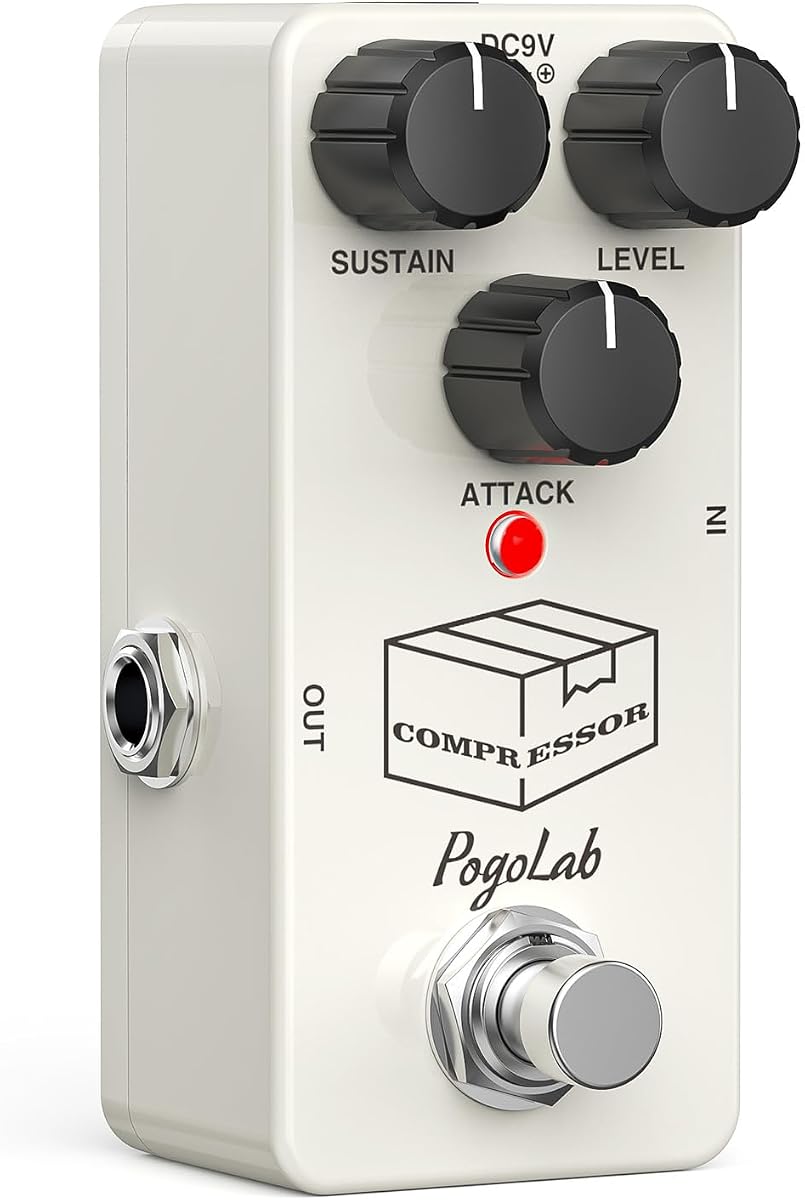
The Pogolab Mini Compressor is a compact, uncomplicated option for electric guitar and bass players who want basic compression without a large control panel. It has a supplied rating of 4.2. Sustain and attack are the two stated performance controls, allowing the user to adjust the compressed duration and the point at which compression begins. An indicator light shows when the pedal is operating, while its small format suits a crowded pedalboard.
We may earn a commission when you buy through this link, at no additional cost to you.
Noise reduction is an explicit focus of the design. According to the supplied information, the circuit was developed to reduce the noise swells that can appear in compressor circuits, making it a practical choice for players who want a controlled effect without unnecessary electrical noise. The aluminum alloy construction also gives the enclosure a practical durability advantage, and sturdy side connectors make the basic one-in, one-out setup straightforward.
True bypass keeps the signal intact when the effect is switched off. The pedal operates from a center-negative nine-volt DC adapter, although neither the cable nor the adapter is included. This is the most important practical consideration for prospective buyers, especially if they do not already have a compatible power supply. Its limited controls are also a compromise: Sustain and Attack can establish the core behavior, but there is no documented separate tone or output control.
The Pogolab is best for a bassist who wants a small, straightforward compressor, already has suitable power, and mainly needs to control sustain and onset. It can serve as a practical first pedal or as a simple addition to an existing board. Players who require precise tonal shaping, extensive feedback, or a broad control set should look elsewhere. Within that narrower brief, the Mini Compressor offers a clean design and durable construction without unnecessary complexity.
Sustain sets the compressed time, while Attack changes the starting time of the effect. With only two primary performance controls, the pedal is easy to understand and quick to adjust between different basses or playing positions.
The product information specifically highlights reduced noise swells as a development goal. This makes the compact compressor appealing when a clean background is important during both practice and performance.
We may earn a commission when you buy through this link, at no additional cost to you.
The Electro-Harmonix Bass Preacher is a compressor and sustainer designed to handle a wide range of bass output levels. Its supplied rating is 4.2, and its input sensitivity extends from -10 dBu to +2 dBu, allowing it to fit both passive and active basses. That broad compatibility makes it a useful choice for players who own more than one instrument or regularly change between electronics with different output characteristics.
We may earn a commission when you buy through this link, at no additional cost to you.
Maximum gain reduction is listed at 21 dB, with enough make-up gain to restore full output level at maximum sustain. An attack toggle offers Fast, Medium, and Slow settings, giving the player three distinct starting points for compression onset. This switch-based approach is not as fluid as a continuously adjustable knob, but it makes the important timing choices easy to identify and compare. The included nine-volt battery also helps the pedal get into service without requiring an immediate trip to the power-supply drawer.
True bypass maintains signal-path integrity when the pedal is off, allowing an unprocessed comparison and making it easier to determine how much the compressor contributes to the overall sound. The potential drawback lies in the available depth of compression. With up to 21 dB of gain reduction, the pedal can deliver a pronounced sustain effect, but the strongest settings may also reduce the dynamic distinctions that many bassists value. A thoughtful setup remains important.
Choose the Bass Preacher for players who need one compressor to cover both passive and active basses, or who prefer a few defined attack settings over a large control panel. It is also compelling for those who want more sustain and are comfortable finding the balance between compressed sustain and retained movement. The combination of broad input compatibility, three attack choices, make-up gain, true bypass, and an included battery makes it a versatile dedicated bass option.
The wide input-sensitivity range allows the compressor to accommodate instruments with substantially different output levels. That versatility is useful for players who switch between passive and active basses without wanting separate compression solutions.
Fast, Medium, and Slow settings provide distinct onset behaviors without requiring continuous adjustment. Players can compare how each setting reacts to notes, chords, and repeated bass lines while keeping the overall sustain control consistent.
We may earn a commission when you buy through this link, at no additional cost to you.
The Universal Audio LA2A Studio Compressor Pedal translates the character of the Teletronix LA-2A optical tube compressor and limiter into a compact stompbox. It has the highest supplied rating in the group at 4.7. Rather than presenting itself as a conventional bass-only dynamics pedal, it offers the response and dimensionality associated with a celebrated studio compressor, making it an intriguing option for bassists interested in classic recording aesthetics.
We may earn a commission when you buy through this link, at no additional cost to you.
The emulation is described as an end-to-end recreation of vintage transformers, tube amplifiers, and the T4 optical cell. Its intended result is a fat, three-dimensional tube tone rather than a neutral transparent effect. A mix control enables parallel compression, allowing the player to blend processed and unprocessed signal for varying degrees of density and sustain. A Stock/Fast attack switch adds another way to compare response characteristics, while true or buffered bypass gives flexibility for different signal chains.
The central trade-off is that the LA2A is not designed around a dedicated bass signal in the same way as the M87, Keeley Bassist, or Bass Preacher. Its studio-compressor character may be too colored or sustained for some players, particularly those who rely on a very clean, articulate low end. Conversely, that distinctive behavior is the reason to consider it. A bassist seeking familiar studio dynamics will find more purpose here than in a generic guitar compressor.
Choose the Universal Audio LA2A when you want a recognizable optical-compressor voice, enjoy parallel blending, and are comfortable shaping the result around your amplifier. It is well suited to studio workflows, layered bass tones, and players who want a clearly identifiable dynamics effect. Those seeking a subtle, bass-specific leveling tool may prefer one of the dedicated models, but the LA2A offers the most distinctive approach and the strongest supplied rating in this comparison.
The pedal recreates the Teletronix LA-2A through modeled transformers, tube-amplifier behavior, and its optical cell. That approach prioritizes a recognizable three-dimensional sound rather than perfectly transparent leveling.
The mix control allows the compressed signal to be blended with the original path. This is valuable when a full, strongly compressed bass line is not quite right but a little density and sustain would improve the arrangement.
We may earn a commission when you buy through this link, at no additional cost to you.
The MXR Dyna Comp Bass Compressor adapts the recognizable Dyna Comp format to the needs of bass players. Its supplied rating is 4.0, the lowest in this group, but the model is still built around a clear purpose: retaining low end, dynamics, and transparency while providing the familiar compression approach associated with the Dyna Comp family. The straightforward design appeals to players who want a familiar compressor voice without navigating a complex control set.
We may earn a commission when you buy through this link, at no additional cost to you.
Output and sensitivity controls set the level and length of sustain, allowing the player to balance the compressed bass against the rest of the signal. The bass-focused circuit is designed to preserve the instrument's fundamental response rather than treating low frequencies as something that should disappear. That makes it a sensible middle ground between an unprocessed bass and a heavily sustained effect, particularly for players who want their note attack and dynamics to remain part of the sound.
Its limitations are mainly about precision and range. There are no dedicated attack, tone, or blend controls documented for this model, so it offers less freedom than the BOSS BC-1X, BOSS CS-3, or Universal Audio LA2A. It may also be less suitable than the M87 for players who want visible gain-reduction feedback, since no status display is listed. The result is a more focused tool that works best for players comfortable establishing a setting and moving on.
The MXR Dyna Comp Bass is a good choice for a bassist who likes classic compression, wants low-end retention, and prefers a small number of practical controls. It can help even out a performance without aspiring to the dramatic sustain of a dedicated compressor-sustainer. Players who require fine-grained control, detailed feedback, or a broad tonal palette should consider those more adjustable alternatives; everyone else may find this straightforward bass adaptation especially easy to live with.
The circuit retunes the classic Dyna Comp concept for bass, with an emphasis on retaining the low end and maintaining transparency. It provides a familiar foundation for players who already understand how this compressor family behaves.
Output and sustain controls cover the two main tasks of balancing the pedal and adjusting the length of the compressed response. The limited layout keeps setup approachable for players who do not want to manage a large set of parameters.
We may earn a commission when you buy through this link, at no additional cost to you.
The MXR Dyna Comp is a general-purpose in-line compressor with a strong reputation as a Nashville studio standard. Its supplied rating of 4.8 is the highest among these products. The pedal is designed to even out a signal before it reaches an amplifier, making it useful for bass players who need stronger and more consistent dynamics but do not want to chase a complex, bass-specific control set.
We may earn a commission when you buy through this link, at no additional cost to you.
Its central purpose is straightforward: compress the signal for more stable dynamics and increase sustain where appropriate. The compression circuit and sensitivity control let the player establish how strongly the effect responds, while the constant output signal provides a consistent level through the pedal. The simple, in-line format also makes it easy to understand as a basic dynamics processor rather than a complex sound-creation tool.
The main compromise is specificity. This is not a dedicated bass pedal, so it may not offer the same tailored response or input flexibility as the M87, Keeley Bassist, or Bass Preacher. It also has only one main performance control, which means it cannot separately shape attack, tone, blend, or sustain. Bassists who want the familiar Dyna Comp voicing may accept that limitation, but those building a precision signal chain may prefer a model with more control.
Choose the MXR Dyna Comp when you want a proven, uncomplicated compressor that can tame uneven dynamics and add useful sustain to a bass part. It is especially appealing to players who appreciate classic studio gear and want a straightforward compressor for practice, recording, or live use. For more specialized low-end shaping, look to the dedicated bass models in this guide; for an established general-purpose compressor with the highest supplied rating, the Dyna Comp remains a compelling choice.
The in-line circuit is designed to even out the signal before it reaches the amplifier. A single sensitivity control is enough to establish the effect, making this a practical choice for players who want a repeatable compressor without extensive tweaking.
The MXR Dyna Comp is described as a Nashville studio standard, reflecting its long-standing place in professional recording workflows. Its compact format also translates naturally to a pedalboard, where it can serve as a general-purpose dynamics processor.
We may earn a commission when you buy through this link, at no additional cost to you.
The right bass compressor depends on how much control you need, the output characteristics of your instrument, and the amount of tonal alteration you are comfortable making. Consider circuit design, attack behavior, feedback, bypass routing, power requirements, and physical format before choosing a model.
A dedicated bass compressor is designed with the instrument's low-frequency range in mind. Models such as the MXR M87, Keeley Bassist, MXR Dyna Comp Bass, and Electro-Harmonix Bass Preacher explicitly target bass, while the BOSS BC-1X uses adaptive multiband processing for the instrument. A general-purpose compressor may still work very well, but it may require more careful balancing to preserve the attack and definition of the low end. Choose a dedicated design when bass response is the priority; consider a general model when you want an established voicing or a compact solution that can also serve other instruments.
Bass outputs vary considerably, and a compressor that handles one instrument cleanly may struggle with another. The Electro-Harmonix Bass Preacher accepts a broad range from -10 dBu to +2 dBu, covering passive and active basses. The BOSS BC-1X provides professional 18-volt input electronics, while the Keeley Bassist is described as capable of handling very large signals. If you use active electronics, play loudly, or want to retain clean dynamics, prioritize ample input headroom and broad instrument compatibility. With passive basses, a conventional compressor may be sufficient, but it should still leave enough headroom to avoid unwanted distortion.
Attack determines how quickly compression begins, while release and sustain influence how long the reduced signal remains. A fast attack can create a denser, more consistent low end, but it may also reduce the impact of every note. A slower attack can preserve more natural variation before the compressor responds. The Electro-Harmonix Bass Preacher provides Fast, Medium, and Slow attack selections, while the M87 bundle includes separate Attack and Release dials. The BOSS CS-3 and Pogolab Mini Compressor also include dedicated Attack controls. Select a model that gives you control over the response, or one with well-defined modes that make experimentation easy.
A compressor can change more than note volume, so consider whether you need a dedicated tone control, blend control, or both. The BOSS CS-3 provides level, tone, attack, and sustain controls for direct shaping. The Universal Audio LA2A includes a mix control for parallel compression, letting you blend the processed and original signals. The M87 bundle offers output, ratio, input, attack, and release controls for more detailed behavior. If you want the pedal to improve a bass line without completely changing its character, look for blend, tone, or other parameters that let you refine the balance.
True bypass routes the signal around the effect when the pedal is off, which is useful for direct comparisons and unprocessed recordings. The MXR M87, M87 bundle, Pogolab Mini Compressor, and Electro-Harmonix Bass Preacher document true bypass. The Universal Audio LA2A offers both true and buffered bypass, adding flexibility for different rigs. Consider the rest of your signal chain as well: passive systems may favor true bypass for the shortest path, while buffered modes can be useful when longer cables or complex routing introduce unwanted effects. The right choice is the one that integrates cleanly with your amplifier, interface, and other pedals.
Knowing when a compressor is working helps you establish a useful setting without flattening the sound. The MXR M87 and M87 bundle use ten gain-reduction status LEDs, and the BOSS BC-1X includes a high-resolution gain-reduction indicator. The Pogolab Mini Compressor uses a simpler operating light, while the other listed models do not document a detailed gain-reduction display. Visible feedback is especially helpful on a stage, where hearing the effect alone can make it difficult to identify the exact compression point. It is also useful during recording, where repeatable setup matters.
Check power requirements and included accessories before finalizing a choice. The M87 bundle includes a Tonebird 9-volt 1500 mA power supply, a ten-foot instrument cable, two patch cables, and a multi-tool. The Electro-Harmonix Bass Preacher includes a nine-volt battery, while the MXR Dyna Comp can operate from a single nine-volt battery or a Dunlop ECB003 AC adapter. The Pogolab Mini Compressor requires a center-negative nine-volt DC adapter, but neither cable nor adapter is included. A dedicated power supply may also be necessary for any pedal with higher voltage requirements. Make sure the pedal's size, connector placement, and power plan fit your board.
Begin with the bass and amplifier sounding as you want them without the compressor. Connect the pedal, engage it, and make the level, tone, attack, and sustain adjustments as the design allows. If the pedal includes gain-reduction feedback, bring the signal above the threshold gradually and watch how many LEDs illuminate. Make small changes, then return to the original bass settings whenever possible so that you can judge the compressor's contribution clearly.
Set the compressor lightly at first. A useful starting point is enough gain reduction to make quiet notes more consistent and sustain more controlled without making every note feel identical. Increase the amount or change the attack only after listening in context with the full band or backing track. For parallel controls such as the Universal Audio LA2A mix setting, begin with a modest blend and raise it gradually. If the pedal has separate output and input or level controls, adjust those after establishing the compression behavior.
To care for the pedal, use the specified power source and observe the correct polarity. Keep the enclosure dry, avoid placing it where moisture or heavy gear can press against the connectors, and loosen cable strain near plugged-in plugs rather than pulling them from the body. When not in use, retract the cables, store the pedal in a dry case, and check the footswitch, knobs, and battery compartment periodically. For a new setup, write down the instrument, amplifier, and pedal settings once you find a tone you want to reproduce.
A bass compressor pedal reduces the contrast between louder and quieter notes by lowering stronger signal levels and often raising softer ones. This can make the bass more consistent, add sustain, and help the instrument sit more clearly in a mix. The audible result depends on the circuit, settings, amplifier, and the player's dynamics.
A guitar compressor can work, but a bass-specific model is usually better aligned with the instrument's frequency range and output characteristics. General-purpose models may offer attractive sounds, particularly in parallel or blended configurations. If using a guitar pedal, begin conservatively and listen closely for unwanted loss of low-end definition.
It can if the settings reduce too much of the bass's dynamic movement without compensating for tonal balance. Start with light gain reduction, use a dedicated bass circuit when possible, and leave headroom in the signal chain. The tone and output controls on models such as the BOSS CS-3 can also help refine the result.
Active basses can benefit from a compressor with enough input headroom because their electronics may deliver a stronger output than passive instruments. The BOSS BC-1X and Electro-Harmonix Bass Preacher are explicitly suited to demanding or varied output levels, while the Keeley Bassist is also designed to handle very large signals. Verify the pedal's input range and power requirements before choosing.
Compression controls how strongly louder portions of the signal are reduced, which can produce a more even response. Sustain is usually a related control that changes how much of the compressed or boosted signal continues. A pedal with separate attack, sustain, output, and ratio controls offers more precise control over the overall behavior.
True bypass is useful because it provides a direct route around the effect when the pedal is switched off, allowing easy comparisons with an unprocessed signal. The importance depends on the rest of the setup, particularly when long cables or other active devices are involved. A pedal with selectable true and buffered bypass offers additional flexibility.
Most bass compressors are placed before the amplifier, allowing the amplifier to shape the already-compressed signal. Placement can vary, especially when using fuzz, overdrive, boost, or other pedals, so compare the result in context. Keep the signal path as uncomplicated as possible and leave adequate headroom throughout the chain.
Use gain-reduction feedback when the pedal provides it and increase the input until the desired threshold is reached. Begin with enough reduction to improve consistency and sustain without eliminating all variation between notes. Compare the compressed and bypassed sounds, then reduce the amount if the bass starts to feel flat or indistinct.
The MXR Bass Compressor is the most balanced overall choice because it combines dedicated bass design, Constant Headroom Technology, true bypass, and ten clear status LEDs. The BOSS BC-1X stands out for adaptive multiband behavior, 18-volt input electronics, low-noise digital circuitry, and detailed gain feedback, while the BOSS CS-3 offers the most approachable manual tonal shaping with level, tone, attack, and sustain controls.
Your instrument and priorities should guide the final choice. Active bassists should look for broad input compatibility and high headroom, while players seeking fine control should prioritize attack, release, blend, and tone parameters. The Keeley Bassist favors high-fidelity limiting, the Universal Audio LA2A delivers a studio-inspired optical character, the M87 bundle supplies useful accessories, and the Electro-Harmonix Bass Preacher offers passive-and-active versatility with selectable attack modes.
Before purchasing, verify the current product listing, included items, power requirements, control layout, and compatibility with your rig. Product configurations and availability can change, so the current listing is the best place to confirm what is actually included. Whatever model you select, make gradual adjustments and judge the compressor in the same musical context you will use when performing or recording.