
BN-LINK 24-Hour Heavy Duty Mechanical Timer
4.5Editor score
15-minute scheduling increments
Daily repeating 24-hour cycle
Built-in pin dial
Heavy-duty electrical rating
ETL listed construction
Our grow light timers guide compares ten programmable, mechanical, outdoor, and countdown models for scheduling indoor grow lights safely and conveniently.
Grow light timers help indoor gardeners maintain consistent lighting schedules without manually switching lamps every day. The most useful model depends on your setup, including whether you need simple daily control, detailed programming, outdoor resistance, or short repeating cycles for pumps and ventilation equipment.
We compared ten timers based on their listed scheduling options, outlet configurations, electrical ratings, display design, safety features, and suitability for grow lights. The guide covers mechanical and digital models, countdown controls, light sensors, and options designed for both indoor and outdoor installations.
Each review identifies the feature that makes a timer stand apart while also noting practical limitations. Ratings and specifications reflect the supplied product information, and although availability and prices change, the recommendations remain focused on the functions that matter most to growers.
4.5Editor score

4.3Editor score

4.5Editor score
The comparison below highlights the timer type, scheduling method, outlet arrangement, and notable capability of each model, helping growers identify the right balance of programming, construction, and installation flexibility.




The BN-LINK Indoor 7-Day Programmable Digital Timer Outlet is a flexible all-purpose option for growers who want repeatable weekly lighting schedules. It carries a 4.3 rating and supports up to eight on/off programs, one-minute intervals, selected days, preset day combinations, and a daylight-saving adjustment. Its defining convenience is the ability to automate two grounded outlets at the same time.
We may earn a commission when you buy through this link, at no additional cost to you.
The weekly programming makes this timer more useful than a basic 24-hour model for indoor gardens that follow a strict photoperiod. A grower can create lighting periods that differ from one day to the next, switch between individual days and convenient combinations, and make relatively small corrections without being limited to half-hour increments. The backup battery helps preserve the configuration if power is interrupted, which is especially valuable in rooms where accidental shutdowns could affect an active grow.
There are two practical compromises. Both outlets are controlled simultaneously, so the timer cannot independently operate a light and a fan on different schedules. Programming also takes more thought than operating a mechanical dial. For a room where all connected equipment should share one lighting plan, however, those limitations are modest compared with the flexibility offered by eight programs and a one-minute minimum interval.
This is the strongest overall choice for an indoor grower who wants detailed scheduling without moving to a more complex controller. It works particularly well when two fixtures or light-supporting devices need to operate in unison. Buyers who need separate schedules for each outlet should favor a digital model with independent controls, while growers wanting basic daily automation may find the simpler mechanical options easier to manage.
Eight on/off program groups give growers room to coordinate a seven-day lighting routine. One-minute settings are unusually fine for a plug-in timer and make it possible to match schedules more closely to a plant-specific photoperiod.
A long-lasting backup battery helps retain programmed settings during a power interruption. Random mode can also vary the operation of connected lights, providing a more natural-looking pattern while the premises are unattended.
We may earn a commission when you buy through this link, at no additional cost to you.
The VIVOSUN Digital Timer Outlet is designed for growers who need many programs and want to operate two devices independently. Its 4.2 rating is supported by a large LCD, up to 20 on/off program groups, a one-minute minimum interval, and a maximum interval of seven days. The side-entry layout is also intended to improve access in tight installations and reduce accidental contact with a side-mounted control.
We may earn a commission when you buy through this link, at no additional cost to you.
Independent outlet control separates this model from many dual-outlet timers. Instead of requiring every connected fixture to follow exactly the same schedule, a grower can use one outlet for a grow light and the other for a fan, pump, or another piece of equipment. The timer also offers preset combinations for common working-day patterns, a random function, a child lock, and a countdown mode accessible through a button combination.
The extensive feature set comes with a learning curve. Shortcut operations for daylight-saving time, AM or PM display, and countdown settings make the functions more discoverable once configured, but they can feel less intuitive than a straightforward mechanical dial. The product information also refers to two independent outlets, so users should verify the final package configuration and intended control layout before installation.
This timer is most appropriate for indoor grow rooms where independent scheduling is valuable and the grower is comfortable configuring a digital interface. It is a particularly good match for setups in which a light and circulation fan follow different routines. Those seeking the simplest possible control should choose a mechanical daily timer instead.
Two independent outlets allow a light and supporting device to follow separate schedules. That flexibility can improve coordination without requiring a second wall timer for every piece of equipment.
Up to 20 program groups make this one of the most configurable models in the guide. A dedicated countdown shortcut adds value when a grower wants a timed shutdown or activation rather than only a repeating daily schedule.
We may earn a commission when you buy through this link, at no additional cost to you.
The BN-LINK 24-Hour Heavy Duty Mechanical Timer Outlet offers dependable daily automation without the complexity of a digital controller. It has a 4.5 rating, an indicator light, a grounded three-prong design, and a built-in dial with 15-minute pins. Each pin represents a quarter hour, allowing as many as 96 on/off settings within a repeating 24-hour cycle.
We may earn a commission when you buy through this link, at no additional cost to you.
Its main strength is the directness of the control system. There is no screen to interpret and no menu to navigate. A grower aligns the dial with the current time, presses the pins down for active periods, and leaves them up for inactive periods. The same daily pattern then repeats, which is suitable for a flower room, propagation area, or any grow space following one consistent light-and-dark cycle.
The tradeoff is obvious: a mechanical 24-hour timer cannot create different schedules for different days of the week. It also provides only one outlet, so another timer may be needed for a fan or pump with a different rhythm. Despite these constraints, the heavy-duty rating of 1875 watts and 15 amps makes it a capable option for typical indoor lighting loads.
This is a practical recommendation for beginners and growers who value reliability, quick setup, and repeatable operation. It is also useful as a backup controller in a larger room. Choose it when one fixed daily schedule meets your needs; move up to a programmable digital timer if changing day-to-day schedules or controlling multiple devices independently is essential.
The 15-minute pin system offers finer control than many mechanical timers while remaining easier to understand than a dense digital interface. It is a good fit for a consistent daily light cycle.
The listed 1875-watt, 15-amp rating provides useful capacity for ordinary indoor grow-light setups. The grounded three-prong construction and ETL listing also make safety certification easy to identify.
We may earn a commission when you buy through this link, at no additional cost to you.
The G-Homa Timers for Electrical Outlets package is built for growers who need to automate several areas at once. It includes four plug-in mechanical timers, each with one polarized outlet, a 24-hour daily cycle, and 30-minute settings. The 4.5 rating reflects a straightforward product whose main advantage is the number of independent units supplied in the pack.
We may earn a commission when you buy through this link, at no additional cost to you.
Having four separate timers allows different grow rooms, propagation shelves, or lighting zones to be scheduled individually. Each unit follows its own daily on/off pattern, so a seedling area can operate on a different photoperiod from a flowering area. The setup process remains simple: turn the dial to the current time, press or pull the pins, and move the manual switch into timer mode.
The limitation is the 30-minute resolution. A grower who needs precise one-minute changes, distinct schedules for each day of the week, or countdown operation will need a more advanced digital model. Each timer also has just one outlet, so the pack does not replace dual-outlet devices when multiple devices share one receptacle.
This pack is a strong match for a multi-zone indoor garden or a grower starting a new collection of simple controllers. It can also divide lighting across several rooms without requiring complex programming. For a single grow area, a dual-outlet timer may be more convenient, but for flexible placement across multiple zones, four independent mechanical units are especially useful.
Four individual units let different rooms or shelves follow separate daily schedules. This arrangement is helpful when plants at different stages require different lighting durations.
The dial-and-pin design avoids complex menus and requires no tools to configure. Once the current time is aligned, the chosen periods repeat automatically every day.
We may earn a commission when you buy through this link, at no additional cost to you.
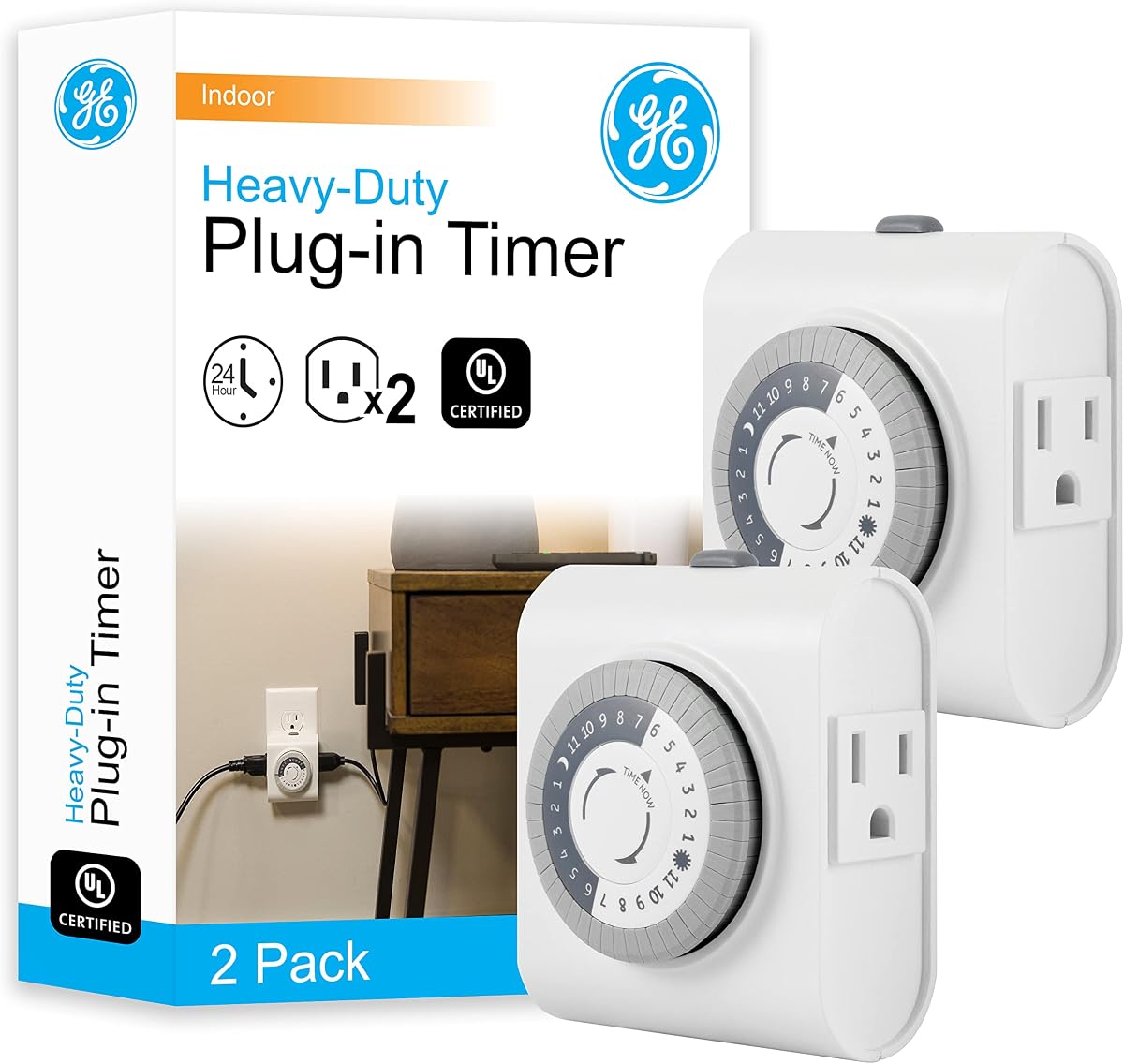
The GE 24-Hour Plug-in Mechanical Timer Outlet has the highest listed rating in this group at 4.6. It is a two-pack of compact mechanical timers, and each unit includes two grounded outlets, 30-minute push-pin scheduling, and a manual override switch. That combination makes it a polished, uncomplicated option for indoor grow spaces.
We may earn a commission when you buy through this link, at no additional cost to you.
Each timer can operate two grounded three-prong devices simultaneously. A grower can connect a light and a small fan, or use one outlet for a lamp while leaving the other available for another seasonal device. The two timers in the pack can be programmed differently and placed in separate rooms, adding more flexibility than a single daily controller.
Mechanical operation means the schedule repeats every 24 hours and cannot account for different weekdays. The 30-minute pins are less precise than the 15-minute system used by some BN-LINK models, but the GE design remains well suited to common photoperiods that begin and end on convenient half-hour boundaries. The override switch can pause automatic operation when a grower wants a light on outside its scheduled period.
This product is a strong choice for a new indoor grower who wants uncomplicated controls, two outlets, and the option to equip more than one room. It also works well for routine indoor lighting where the same schedule is needed every day. Users seeking minute-level precision, weekly variation, or countdown automation should choose a digital timer instead.
Each timer controls two grounded outlets at once, reducing the need for separate controllers when a grow-light setup includes more than one plug-in device.
The 30-minute push-pin controls make the daily schedule easy to read at a glance. A manual override also gives the grower temporary control without dismantling the programmed dial.
We may earn a commission when you buy through this link, at no additional cost to you.
The DEWENWILS Indoor 24 Hour Programmable Digital Timer Outlet is a compact two-pack with a 4.5 rating. It supports three daily repeat groups, including Always On, Auto, and Always Off modes. Its large display, one-minute precision, and side controls make it approachable for growers who want more flexibility than a mechanical dial without using a dense multiweek interface.
We may earn a commission when you buy through this link, at no additional cost to you.
The compact form is particularly useful in crowded indoor grow rooms where a large plug-in controller might block an adjacent receptacle. Smooth sides and a frosted front help it blend into the surrounding space, while the display keeps the current mode visible. Silent operation is another useful trait in a bedroom, office, or other room where relay clicks could be distracting.
The memory function is a meaningful advantage because programmed settings can remain available for up to three months after a power interruption. The limitation is scope: the product provides a 24-hour daily program rather than a multiweek schedule, and each unit has one outlet. Growers whose plants follow the same routine every day can use it effectively, but those requiring different weekday programs need a more capable controller.
This digital timer is best for users who value a clear screen, silent operation, and compact construction but do not need extensive weekly programming. It also works well as a two-zone solution because the pack includes two units that can be set separately. Those needing independent dual-outlet control or light-sensor automation should look elsewhere in this guide.
The small profile is designed to avoid blocking nearby sockets. That makes it convenient in indoor grow rooms where extension cords and several plug-in devices can leave little free space.
Silent switching is useful in occupied rooms, while the extended memory helps protect a daily schedule after an outage. The display also makes the active mode easy to confirm.
We may earn a commission when you buy through this link, at no additional cost to you.
The BN-LINK Heavy Duty Dual Outlet Mechanical Timer combines a 15-minute interval system with two grounded outlets. It carries a 4.4 rating and supports an on period ranging from 15 minutes to 24 hours, making it useful for both full-day grow-light schedules and shorter equipment cycles. A manual switch can bypass the timer when continuous operation is needed.
We may earn a commission when you buy through this link, at no additional cost to you.
The built-in pin dial eliminates the loose parts associated with some mechanical timers. Instead of removing and storing individual pins, a grower presses the relevant controls down for on periods and leaves them raised for off periods. Once set, the schedule repeats every 24 hours, providing a dependable way to operate lamps, hydroponic equipment, fans, and other compatible loads.
Both outlets follow the same program. This is convenient when two fixtures should illuminate simultaneously, but it does not accommodate a light and fan that need independent timing. The timer also lacks weekday variation and countdown functions. Its mechanical nature is easy to maintain, though the dial must be set accurately against the current time.
This model is a good compromise for a grow room that needs more than one connected device but does not require different schedules for each one. It is especially attractive for growers who prefer 15-minute precision over the half-hour steps common on other mechanical timers. For independently scheduled equipment, choose a digital model with two independent outputs.
Two outlets can run matching light fixtures or other equipment on one schedule. This keeps installation simple when every attached device should remain synchronized.
The timer can sustain an on period from 15 minutes through 24 hours. That range accommodates both a short circulation cycle and a full daily lighting period.
We may earn a commission when you buy through this link, at no additional cost to you.
The BN-LINK Outdoor 24-Hour Mechanical Timer Outlet is the guide's dedicated outdoor model. It has a 4.5 rating, a rainproof casing, two grounded outlets, and 48 mechanical pins representing 30-minute intervals. Its outdoor construction makes it better suited to patio, yard, garden, and landscape applications than the indoor timers in this list.
We may earn a commission when you buy through this link, at no additional cost to you.
The timer repeats its daily program automatically and is designed to retain pin settings if power fails. That persistence is useful for exterior lights because a reset schedule can take time to recreate. Two outlets allow a grower or gardener to operate string lights and another compatible device at the same time, while the listed 15-amp and half-horsepower rating covers common outdoor lighting loads.
Outdoor installation requires attention to the stated placement guidance. The product information specifies mounting the unit upright and two feet above the ground. A rainproof housing does not mean the timer should be submerged or positioned where pooling water can reach it, and the connected equipment must also be suitable for the location.
This is the appropriate choice for exterior grow lights or garden lighting where weather resistance matters. It is less relevant to a completely indoor grow room, where a compact digital or dual-outlet mechanical timer may be easier to operate. The model is especially useful for a creator who wants dependable daily control without navigating an electronic interface.
The rainproof casing is intended for outdoor installations where ordinary indoor controllers would be vulnerable to weather. The required upright position also helps protect the electrical connection.
The 48-pin system creates a repeating 24-hour program for exterior lighting. The settings are designed to remain in place following a power failure, reducing the need for manual reprogramming.
We may earn a commission when you buy through this link, at no additional cost to you.
The Techbee Indoor Digital Infinite Repeat Cycle Intermittent Outlet Timer is the most multifunction-oriented model in the guide. Its 4.4 rating accompanies support for a 24-hour clock, three daily on/off programs, countdown operation, on/off control, and a customizable infinite repeat cycle. The pack includes two individual timers for controlling separate outlets or rooms.
We may earn a commission when you buy through this link, at no additional cost to you.
The infinite repeat function is the main attraction. It can support equipment that must cycle repeatedly rather than follow one long on period and one long off period, making the timers potentially useful for circulation fans, pumps, or other short-cycle accessories. Countdown delay adds another layer of control, and the large display makes the selected mode easier to monitor.
That versatility also increases the setup effort. A grower who only needs one fixed daily lighting schedule may find a dedicated mechanical model easier. The internal battery preserves programmed settings during outages, and the child lock helps reduce accidental changes, but the combination of modes still requires careful setup. The fireproof housing and child lock add reassurance, while silent operation suits home environments.
This is a strong recommendation for indoor growers who want one timer to handle several types of schedules. The two-pack also offers separate control locations. It is best suited to technically comfortable users who will take time to configure the modes and check that the selected cycle matches the equipment attached to each outlet.
Clock mode, daily programs, countdown, and infinite repeat cycles cover several common automation needs. This versatility is useful when lights and circulation equipment require different patterns.
A large screen helps users verify digits and operating modes. The built-in battery protects programmed settings during a power interruption, while silent operation keeps the timer practical in occupied rooms.
We may earn a commission when you buy through this link, at no additional cost to you.
The BN-LINK Short Period Repeat Cycle Intermittent Timer is built around a photocell and short repeating cycles rather than a conventional clock-based lighting calendar. It has a 4.5 rating, a grounded three-prong outlet, and selectable Day Only, Night Only, and 24-Hour modes. That makes it especially relevant to growers using natural-light cues or operating ventilation and irrigation accessories around changing ambient light.
We may earn a commission when you buy through this link, at no additional cost to you.
Its cycle controls are unusually granular. On periods can run from five seconds to 30 minutes, while off periods range from five seconds to 60 minutes. These intervals support short, repeated equipment operation and are far more flexible than the half-hour or quarter-hour periods offered by standard mechanical wall timers. The result is a useful controller for pumps, humidifiers, fans, sprinklers, and controlled growing systems.
A photocell timer behaves differently from a programmable digital timer. It responds to detected light conditions, so it does not directly create a fixed 18-hour or 12-hour crop schedule. It is also not the best choice for a grower who needs precise clock-based control. Its heavy-duty 1875-watt rating, ETL listing, and simple dials compensate for this specialized purpose, but it should be selected for cycle control rather than treated as a general weekly scheduler.
This is the most specialized and premium-featured recommendation in the guide. It is well suited to a grower who wants automatic day-and-night response or short repeating cycles for environmental equipment. For a standard indoor light schedule, choose a seven-day digital timer; for a fixed daily schedule, a mechanical timer remains easier to configure.
The built-in photocell lets the timer respond to changing light conditions without a conventional daily clock schedule. Day, night, and 24-hour modes provide useful flexibility for different controlled environments.
On durations beginning at five seconds and off durations beginning at five seconds support short repeating operations. These controls are valuable for pumps, fans, humidifiers, and other auxiliary equipment rather than a basic grow lamp.
We may earn a commission when you buy through this link, at no additional cost to you.
The right timer depends on your lighting routine, the number of devices you need to control, and the level of programming you want. Review schedule flexibility, electrical capacity, outlet arrangement, installation conditions, and safety features before choosing a model.
A 24-hour mechanical timer is the simplest option when a room follows the same on and off period every day. It is easy to configure, does not require menu navigation, and can use quarter-hour or half-hour increments depending on the model. A seven-day digital timer is better when the photoperiod changes between weekdays, weekends, or growth stages. Digital models may also provide one-minute precision, multiple programs, and countdown modes, so compare the number of program groups rather than judging only by the screen size.
Count the devices that need control before choosing a timer. A single-outlet model can control one fixture but may leave the adjacent receptacle accessible. A dual-outlet timer can run two devices, although many models control both outlets simultaneously. Independent digital outlets provide greater flexibility when a light and fan require different schedules. For grow rooms spread across multiple shelves or rooms, a multi-pack of individual timers can be more useful than one large dual-outlet unit.
The timer's amperage and wattage rating must comfortably support the combined load of the grow lights and any attached equipment. Listed specifications differ among the reviewed models, with several supporting 15 amps and some showing a 1875-watt maximum. Do not assume every LED grow light draws the same amount; account for the fixture, ballast, fans, pumps, and any other connected devices when evaluating the total.
Scheduling resolution determines how closely a timer can reproduce a desired photoperiod. Thirty-minute mechanical increments are usually adequate for broad lighting windows, while 15-minute pins provide greater flexibility. Digital models can offer one-minute settings and several program groups. If your schedule depends on a precise flowering or vegetative period, finer resolution is worthwhile. If the room simply needs broad on and off periods, a mechanical dial remains easier to maintain.
Indoor grow rooms can use almost any listed indoor model, but exterior installations require a timer explicitly designed for outdoor use. The outdoor BN-LINK model has a rainproof casing, two grounded outlets, and mounting guidance that requires an upright position at least two feet above the ground. An indoor timer should not be moved outside merely because its plug or housing looks weather resistant. Outdoor-rated electrical equipment and safe placement remain essential.
Program memory can prevent a power interruption from erasing a carefully configured lighting schedule. The reviewed digital timers use backup batteries or memory functions, and the outdoor mechanical model is described as retaining its pin settings following a failure. Memory is particularly useful in unattended grow rooms because a reset timer can leave lights off or on unexpectedly. Check the stated retention behavior, and recheck the clock after an extended outage when accuracy is critical.
The easiest timer to use is not always the one with the most modes. Mechanical models offer a direct relationship between the dial, the current time, and the daily schedule. Digital models provide better timing resolution and more automation but require button combinations, mode selection, and careful programming. Choose a basic model for a straightforward room, or a feature-rich controller when you genuinely need independent schedules, countdowns, random operation, or short repeating cycles.
Look for a grounded three-prong design, a suitable electrical rating, and recognized safety certification. Several models in the guide are ETL or UL listed, while the Techbee timer lists fireproof housing and a child lock. These details help indicate attention to electrical and household safety, although certification does not replace correct installation. Keep timers dry, avoid overloading receptacles, and position controls where they will not be bumped during routine plant care.
Begin by identifying the equipment that will be connected and confirming that its combined electrical load falls within the timer's listed rating. For a mechanical timer, turn the dial to the current time before setting the on and off pins. For a digital model, set the clock accurately, select the correct operating mode, and create the desired on and off periods. Test the schedule by briefly placing the timer in manual or always-on mode before leaving it to operate automatically.
Program the schedule according to the needs of the plants rather than simply copying a generic light duration. Use the same daily pattern for each weekday when a mechanical timer is appropriate, or assign separate weekly programs on a digital model when the routine changes. For a photocell timer, place the sensor where it can detect the relevant ambient light without being shaded by a grow fixture. After configuration, verify every interval and confirm that attached equipment behaves as expected.
Inspect the timer and plugs periodically for heat, discoloration, moisture, or mechanical damage. Keep indoor models away from splashing water and never exceed the listed load. Outdoor models should remain upright and at least two feet above the ground as specified. After a power outage, check the clock, active program, and physical connections rather than assuming the previous schedule resumed correctly. Unplug the device before cleaning it, and never open a timer enclosure unless its instructions explicitly authorize servicing.
Mechanical timers are usually easier to program and work well when the same schedule repeats every day. Digital timers provide better precision, multiple programs, independent outlets, countdown modes, and memory after outages. The better choice depends on how much your lighting routine varies and how much programming complexity you want to manage.
Yes, if the timer has multiple outlets and the connected equipment remains within its electrical rating. Many dual-outlet timers switch both outlets at the same time, while some digital models control them independently. Check whether independent scheduling is necessary and verify the combined amperage and wattage of every attached device.
A seven-day timer is helpful when your photoperiod changes by day, such as a different schedule for weekends or growth stages. A 24-hour mechanical timer is sufficient when every day uses the same lighting window. Some growers also prefer digital controls because they provide finer settings and easier schedule review.
A timer with short repeating cycles is most suitable for equipment that must run intermittently. The BN-LINK Photocell Cycle Timer, for example, supports on periods beginning at five seconds and offers day, night, and 24-hour modes. A countdown or infinite-repeat digital timer can also work when the required interval is known and configured correctly.
It is best not to use an indoor-only controller in a wet exterior location. Select a model specifically listed for outdoor use, follow its mounting orientation, and keep the electrical connection above standing water. Even a rainproof housing does not make every indoor timer suitable for every outdoor installation.
The dial may not have been aligned with the current time when the pins were set, or the schedule may have been moved after programming. Turn the dial to the current time, reset the desired pins, and place the manual switch in timer mode. It is also important to distinguish the time-dial orientation from the program-pin positions.
Several digital models in this guide include backup batteries or memory functions, and the outdoor mechanical timer is described as retaining its pin settings. Retention periods and behavior vary by model, so check the product information. After a prolonged outage, verify the clock and test the schedule even if the program appears to have been preserved.
Thirty-minute settings are usually sufficient for broad lighting windows, while 15-minute controls offer a closer match to common photoperiods. One-minute digital precision is useful for detailed schedules or coordination with other equipment. Choose the least complicated resolution that still meets the schedule your plants require.
The BN-LINK Indoor 7-Day Programmable Digital Timer Outlet is the most versatile overall choice for indoor growers because it combines eight programs, one-minute settings, two outlets, and backup memory. The BN-LINK 24-Hour Heavy Duty Mechanical Timer Outlet stands out as the best budget-oriented option for a fixed daily routine, while the BN-LINK Short Period Repeat Cycle Intermittent Timer offers the most specialized automatic and short-cycle control.
Prioritize the scheduling method that matches your actual routine rather than choosing by feature count alone. A mechanical daily timer is easier to manage, a seven-day digital timer is better for changing programs, a dual-outlet model reduces clutter, and a photocell or infinite-repeat timer suits specialized equipment. In every case, verify the electrical load, grounding, installation environment, and available outlet space before purchasing.
Current prices and product availability can change, so check the latest listing before making a final decision. Review the product title carefully, compare the programming features against your schedule, and confirm that the timer and connected grow-light equipment are appropriate for the location. The right model is the one that provides the required timing function reliably without adding unnecessary setup complexity.
