
DEWALT 4 1/2-Inch Cut-Off Wheel
4.7Editor score
Thin cutting profile
Two fiberglass layers
Broad metal compatibility
Grinding disc wheels are among the most versatile consumables for angle grinders, but the right wheel depends on the work. A thin cutting disc slices through pipe and rebar, a depressed-center grinding wheel removes weld beads, and a flap disc blends, deburrs, and finishes rough edges.
The products in this guide were compared using their stated dimensions, abrasive materials, reinforcement, grain or grit, intended applications, grinder compatibility, and maximum operating speed. The list covers ten real options spanning cutting discs, grinding wheels, and zirconia flap discs for metalworking and related finishing tasks.
Each review highlights the strongest use case, construction details, compatibility, and practical trade-offs so you can distinguish a true multipurpose wheel from one designed for a narrower job. Product availability and prices can change, so confirm current details and the latest safety information before purchasing.
4.7Editor score
4.8Editor score

4.7Editor score
As an Amazon Associate we earn from qualifying purchases.
This side-by-side comparison shows each wheel's abrasive type, physical format, primary job, and grinder fit, helping you match the disc to the material and technique instead of comparing all products as interchangeable accessories.


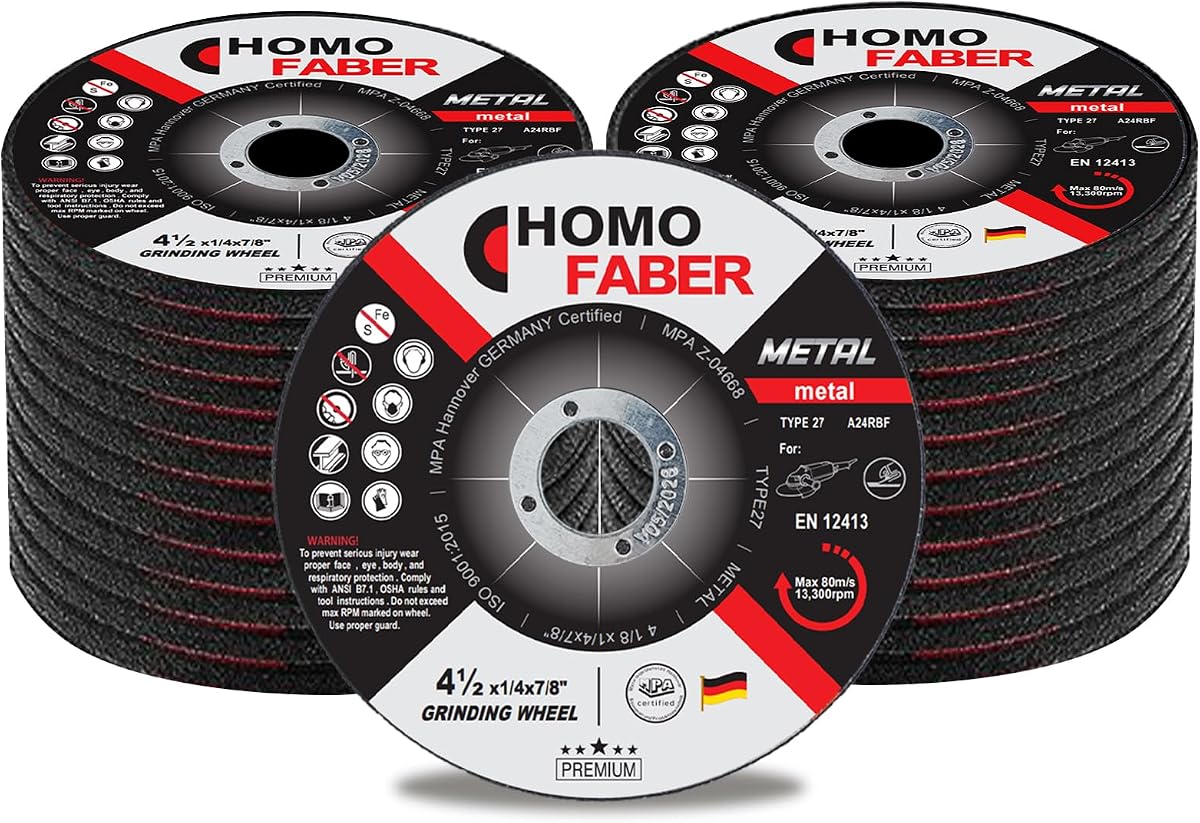
The HOMO FABER 25 Pack is a general-purpose metal grinding option with a 4.8 rating, the highest among the products reviewed. Its 46-grit aluminum oxide construction, depressed-center Type 27 profile, and fiberglass-reinforced layers position it as a practical wheel for weld cleanup, rust removal, edge profiling, and general surface preparation.
We may earn a commission when you buy through this link, at no additional cost to you.
The 46-grit abrasive is coarse enough for meaningful stock removal while remaining more broadly useful than a very aggressive dedicated cutting disc. Fiberglass reinforcement is intended to provide side-load strength, and the stated balance characteristics help reduce wobble during extended grinding sessions. The Type 27 depressed center also gives the wheel clearance from the grinder's guard.
This wheel is not a universal answer for every application. Its focus on metal means it is better suited to weld beads, carbon steel, stainless steel, and cast iron than to delicate finishing, while the 7/8-inch arbor means it will not suit a grinder requiring a 5/8-inch bore. The 25-disc pack is also more substantial than a small trial assortment.
It is an excellent choice for fabricators, repair technicians, and serious do-it-yourself users who want a stocked supply of a consistent metalworking wheel. Between its strong rating, aggressive removal claims, high operating-speed specification, and individually wrapped presentation, it stands out as the most complete general-purpose pick in this guide.
The 46-grit aluminum oxide layer is intended to pull down welds, rust, and mill scale in fewer passes. That makes the disc especially useful when speed of stock removal matters more than a decorative surface finish.
The depressed center clears the guard, while the 7/8-inch arbor fits many standard 4.5-inch corded and cordless grinders. Always verify both grinder dimensions and wheel speed before installation.
We may earn a commission when you buy through this link, at no additional cost to you.
The DEWALT DW8062B5 5 Pack is a thin cut-off wheel with a 4.7 rating and a clear focus on metal cutting. Its 4.5-inch diameter, 0.045-inch profile, and 7/8-inch arbor make it a familiar match for many handheld angle grinders used in fabrication, repair, and construction work.
We may earn a commission when you buy through this link, at no additional cost to you.
The product information highlights a high concentration of aluminum oxide grain and a thin design intended to produce fast cuts. It is listed for carbon steel, stainless steel, nickel-based alloys, steel, angle iron, pipe, tubing, and rebar, giving it broader utility than a wheel formulated for only one alloy or workpiece.
Two sheets of fiberglass are incorporated for wheel strength, and the manufacturer says the construction is designed to reduce breakage. Even so, like every abrasive wheel, it requires proper storage, installation, guard positioning, and handling. It should not be confused with a thicker grinding wheel: its narrow profile is optimized for cutting and may chip or wear quickly if used for prolonged stock removal.
This is a practical pick when the primary requirement is clean metal cutting rather than surface blending. The five-disc pack keeps storage simple, and the 4.7 rating reflects favorable customer reception. It is a sensible option for owners who already own a compatible grinder and need a straightforward, established cutting-disc format.
The 0.045-inch thickness creates a narrow cutting edge that is intended to reduce material loss. That profile can be especially useful when cutting pipe, angle iron, or narrow sections where excess kerf affects the finished part.
Two fiberglass layers add side-load strength, while the aluminum oxide grain is designed for fast cutting. Users should still avoid side grinding, excessive force, and loading the edge on material that can cause the wheel to bind.
We may earn a commission when you buy through this link, at no additional cost to you.
The EZARC Type 29 40-grit set is a zirconia flap disc option rated 4.7. Unlike a rigid grinding wheel, its layered abrasive construction is designed to work on an edge or contour, making it especially useful for removing weld reinforcement, shaping corners, and blending raised areas.
We may earn a commission when you buy through this link, at no additional cost to you.
Zirconia is the defining feature because the product information says it lasts longer than standard aluminum oxide abrasives. The 40-grit surface is deliberately coarse for heavier stock removal, while the Type 29 bevel provides a 15- to 20-degree working angle. This geometry gives the disc useful access to the edge and corner of a workpiece.
The fiberglass and adhesive bond is intended to absorb vibration and maintain stable grinding without contaminating the work surface. The listed applications include grinding, blending, sanding, finishing, deburring, polishing, and rust removal on metal or wood. That versatility is useful, although users needing a very smooth cosmetic finish should move to a finer-grit flap disc.
This is the premium pick for users who regularly remove weld spatter, clean fabrication seams, or need access around rounded edges. The abrasive durability, angled profile, and 4.7 rating make it a compelling option for workshops and metalworkers who want more than a basic flat disc.
The zirconia abrasive is formulated to resist wear better than conventional aluminum oxide. That makes the disc well suited to repeated stock removal and weld cleanup where a standard abrasive disc may wear quickly.
The Type 29 bevel places the abrasive at an angle, helping the disc reach corners, contours, and welded seams. It is more maneuverable than a flat grinding wheel for many finishing applications.
We may earn a commission when you buy through this link, at no additional cost to you.
The 26-Pack Angle Grinder Kit is a mixed-warehouse option for users who want cutting, grinding, and flap-disc capability from one 4.5-inch set. Its 4.6 rating reflects a convenient combination, but the real advantage is variety: 20 cut-off wheels, three 60-grit flap discs, and three grinding wheels are included.
We may earn a commission when you buy through this link, at no additional cost to you.
The cut-off wheels use corundum and white alumina with double fiberglass mesh and a thin 1/25-inch profile. The flap discs use zirconia alumina, while the grinding wheels are described as having three full fiberglass sheets and a high grain concentration. Together, these formats cover rough cutting, stock removal, edge work, and light blending.
A potential drawback is that the included quantities are heavily weighted toward cut-off wheels. Buyers whose main need is general grinding may find only three dedicated grinding discs, while users focused on blending may also want finer grit. The listing also uses inconsistent thickness notation, so the physical dimensions should be checked carefully before use.
This kit is best for a new angle-grinder owner, a maintenance technician, or a workshop that wants a readily available mix of common consumables. The included plastic case also makes storage easier. It is less attractive for a specialist who knows exactly which wheel and grit they need.
The assortment prevents the need to buy separate formats for basic metal preparation. It can cover cutting and grinding on the same day, although the distribution is weighted toward cut-off wheels.
Corundum, white alumina, and zirconia alumina give the included wheels different working characteristics. Those differences allow a sensible progression from cutting to grinding and edge work.
We may earn a commission when you buy through this link, at no additional cost to you.
The DEWALT DW4523 is a 4.5-inch general-purpose grinding wheel with a 4.7 rating. Its 0.25-inch thickness and 5/8-inch arbor distinguish it from the thinner cutting discs and 7/8-inch grinding wheels in this guide, making compatibility the most important purchasing consideration.
We may earn a commission when you buy through this link, at no additional cost to you.
Aluminum oxide grain is used for long service life and high material removal, while a high grain concentration is intended to produce aggressive grinding and smoother running. Three full sheets of fiberglass provide the stated reinforcement. Together, these features point to a useful wheel for shaping metal, cleaning welds, and working edges or surfaces.
The main limitation is the 5/8-inch arbor. Although the wheel can be mounted on a compatible grinder with an appropriate flange or adapter, it will not directly fit every tool that accepts 7/8-inch wheels. The listing also does not identify the abrasive grit, which makes it harder to compare its exact aggression with wheels that state 24 or 46 grit.
For a metalworker with a 4.5-inch grinder requiring a 5/8-inch bore, this is a straightforward and well-regarded option. Its three-sheet reinforcement and general-purpose construction make it a sensible first grinding wheel for routine shop use rather than a specialized finishing product.
The quarter-inch profile provides more material for aggressive grinding than a thin cut-off wheel. It is designed to withstand the side loading associated with shaping and edge work.
The 5/8-inch arbor is the defining fitment detail. Check the grinder spindle and any manufacturer-supplied flange before ordering, and never force a wheel onto an incompatible arbor.
We may earn a commission when you buy through this link, at no additional cost to you.
This 10-Pack Cut-Off Wheel set has a 4.7 rating and targets metal cutting, including stainless steel. Its 0.045-inch thickness, 7/8-inch arbor, and stated 13,300-RPM maximum operating speed fit a common 4.5-inch angle-grinder configuration.
We may earn a commission when you buy through this link, at no additional cost to you.
Its most interesting technical feature is the dual alumina composition. White alumina is intended for stainless steel, while brown alumina supports cutting carbon steel. Combining them in one disc gives the set broader utility than a wheel explicitly optimized for only one family of metal.
The thin profile is designed to reduce material waste and support smooth, precise cuts in steel pipe and rebar. Reinforcement is also claimed for improved wear resistance, although the listing does not specify the number of fiberglass layers. As with other thin cutting wheels, side grinding and excessive radial pressure can cause damage or failure.
This set is a good fit for maintenance crews, fabricators, and homeowners who need a supply of small metal-cutting consumables. It is particularly useful when both stainless and carbon steel appear in the same project, because the user does not need to switch between differently formulated wheels.
White and brown alumina address stainless and carbon steel respectively. This blended formulation is intended to balance cutting speed, durability, and versatility across common ferrous metals.
The narrow 0.045-inch kerf removes less material than a thicker wheel. That is valuable when cutting measured tubing or sheet and when the cut line must be close to a finished dimension.
We may earn a commission when you buy through this link, at no additional cost to you.
The BHA 5 Pack is built for demanding metal grinding, with a 4.7 rating and an explicitly coarse 24-grit aluminum oxide abrasive. Its quarter-inch Type 27 depressed-center format gives it the profile of a stock-removal wheel rather than a delicate finishing disc.
We may earn a commission when you buy through this link, at no additional cost to you.
The product is aimed at carbon steel, stainless steel, cast iron, and other ferrous metals. The listed jobs include weld cleanup, mill scale, rust, burrs, and edge preparation. A 24-grit wheel removes material quickly, which makes it a logical choice for taking down substantial weld reinforcement before moving to a finer finishing stage.
Fiberglass reinforcement through the disc is intended to provide side-load strength, while the stated flat, balanced construction is designed to reduce wobble and vibration. Those traits are important on heavy stock removal, where an unstable disc can chatter, load unevenly, or become hazardous. The 13,300-RPM speed rating should still be checked against the grinder and wheel markings.
This is a compelling choice for welders and fabricators who prioritize fast cleanup over a smooth cosmetic result. The coarse grit may leave visible grinding marks, so users finishing a visible surface should follow it with a flap disc. For weld removal and rough shaping, however, that aggressive profile is exactly what is needed.
The 24-grit aluminum oxide is built for heavy stock removal. It is especially effective for knocking down weld beads, mill scale, and surface buildup before finer blending.
Fiberglass running through the wheel adds resistance to the lateral stresses created during shaping and edge work. Proper pressure, guard clearance, and wheel orientation remain essential.
We may earn a commission when you buy through this link, at no additional cost to you.
The SALI 50 Pack is a bulk general-purpose grinding-wheel option with a 4.6 rating. Its 4.5-inch diameter, quarter-inch thickness, 7/8-inch arbor, and depressed-center design align it with common angle grinders used for routine fabrication and maintenance.
We may earn a commission when you buy through this link, at no additional cost to you.
The product information emphasizes a strong removal rate, low vibration, smooth running, and reduced clogging and chatter. Aluminum oxide is appropriate for general metal work, and the stated applications include solid construction steel, tool steel, high-speed steel, and sheet steel. The depressed center supports aggressive grinding while clearing the tool guard.
The main limitation is that no exact grit is given. A user cannot confidently compare its removal rate with the explicitly 24-grit BHA or 46-grit HOMO FABER wheel. It may be a sensible general-purpose selection, but it offers less control for a specific material or finish. The 50-disc quantity also demands adequate dry storage.
This pack makes the most sense for workshops, contractors, and fabricators who consume wheels regularly and want a large supply on hand. If one wheel proves effective for typical steel work, the quantity reduces frequent replacement. Buyers seeking a particular grit or cutting performance should choose a more precisely specified option instead.
Fifty discs are useful for users who grind frequently and dislike running out of consumables mid-project. The pack is intended to support ongoing steel preparation and fabrication work.
The listing highlights low vibration and smooth running as operator-focused benefits. Balanced operation can improve control when shaping edges or cleaning broad metal surfaces.
We may earn a commission when you buy through this link, at no additional cost to you.
The 10-Pack Aluminum Oxide Grinding Wheels offer a 4.5 rating and a broadly applicable 4.5-inch format. Their quarter-inch thickness and depressed-center construction identify them as grinding wheels for edges, surfaces, rust, burrs, and general metal preparation rather than thin cutting consumables.
We may earn a commission when you buy through this link, at no additional cost to you.
Industrial-grade aluminum oxide is stated to deliver a high removal rate. Triple-layer fiberglass mesh is intended to improve strength and stability, while a 13,300-RPM maximum speed and 80 M/S specification are included for compatibility guidance. The listed metals include steel, stainless steel, aluminum, copper, and others.
Its claimed heat dissipation and extended lifespan are attractive for demanding sessions, but the listing does not identify an exact grit. That makes its performance harder to predict than a wheel with a stated abrasive grade. It is also the lowest-rated product here at 4.5, although that still represents generally favorable customer feedback.
The set is a reasonable choice for a user who needs a moderate supply of general grinding wheels and values broad material compatibility. Verify the grinder's wheel rating and guard requirements, and use appropriate personal protective equipment. For projects with a precisely known grit or a visibly finished surface, a more specialized flap disc may be the better choice.
Triple-layer fiberglass mesh is intended to add strength and reduce instability under pressure. The depressed-center profile supports access to edges, contours, radii, and flatter surfaces.
The wheel is described for steel, stainless steel, aluminum, copper, and various other metals. Users should still confirm that the abrasive and operating speed are appropriate for each specific material.
We may earn a commission when you buy through this link, at no additional cost to you.
The Trivd Frol 40 Pack is the most flexible finishing assortment in the guide, with a 4.6 rating. It includes 20 40-grit, 10 60-grit, five 80-grit, and five 120-grit Type 29 flap discs, all measuring 4.5 inches with a 7/8-inch arbor.
We may earn a commission when you buy through this link, at no additional cost to you.
Zirconia abrasive is used for longer life than standard aluminum oxide, while the fiberglass backing is intended to absorb vibration and prevent smearing. The 13,300-RPM rating and angled Type 29 geometry support fast work on contours, flat surfaces, edges, and welded seams.
The included grit range makes it easy to move from stock removal to progressively finer finishing without buying separate packs. The coarsest 40-grit discs handle heavier work, while 60-, 80-, and 120-grit options refine the surface. The product should not be used on concrete or stone, an important limitation for users with general-purpose grinding expectations.
This set is well suited to users who weld, fabricate, repair, or restore metal and want a comprehensive finishing supply. It can also work on wood, composites, and plastics as stated. The 40-disc quantity is generous, and the mix of grits creates more flexibility than a single-grit option.
Four grit levels let the user move methodically from aggressive cleanup to a smoother finish. That progression is useful after weld grinding or when blending a visible edge.
The fiberglass backing is designed to absorb vibration during contact. The product information also emphasizes reduced smearing, helping preserve workpiece appearance during blending and finishing.
We may earn a commission when you buy through this link, at no additional cost to you.
Choosing an effective wheel requires matching its abrasive, thickness, shape, reinforcement, and dimensions to the intended job and grinder. The most important distinction is whether you need to cut, remove substantial material, or progressively blend and finish a surface.
A cut-off wheel is thin and intended to sever metal, while a grinding wheel is thicker and designed to remove weld beads, scale, rust, and other material. Flap discs use layered abrasive to blend edges, sand contours, deburr, and finish surfaces. A type of grinder disc used for cutting can wear rapidly when asked to perform heavy grinding, while a thick grinding wheel is unnecessarily inefficient for a clean cut.
Choose the format that matches the result you need: thin cutting disc for separation, rigid grinding wheel for stock removal, and flap disc for shaping and finishing.
Most products in this guide measure 4.5 inches in diameter, but arbor size varies. A 7/8-inch wheel will not necessarily mount on a grinder designed for a 5/8-inch spindle, and changing the flange does not automatically make every wheel appropriate. Check the grinder's wheel-marked diameter, spindle size, and manufacturer instructions before ordering.
Match both the wheel diameter and bore to the tool. Use an approved adapter only when the grinder and wheel manufacturer allow it.
Lower grit numbers are coarser and remove material more aggressively, while higher numbers produce finer results. A 24-grit wheel is suitable for substantial weld cleanup, 40 and 46 grit suit general stock removal, and 60 to 120 grit are more appropriate for blending and refinement. Aluminum oxide is an economical general-purpose abrasive, while zirconia is positioned for greater durability.
Pick the grit for the task and the abrasive for the workload. Coarse is not automatically better, and a wheel with no stated grit offers less certainty for a precise finishing sequence.
Fiberglass reinforcement helps a grinding wheel tolerate side loads, which occur during edge shaping and weld cleanup. Products in this guide use two sheets, three full sheets, or triple-layer mesh depending on the model. More layers do not make unsafe use acceptable: excessive pressure, incorrect installation, damaged wheels, and unsuitable tasks can still cause failure.
Choose reinforcement appropriate for the work, then inspect the wheel before every use. Replace it if cracks, chips, tears, or deformation are visible.
The operating speed of the wheel must not exceed the maximum speed marked on the grinder. Several products in this guide state a maximum of 13,300 RPM, while others do not provide that detail in the supplied information. A wheel that is too small for the tool can operate beyond its safe speed, and a wheel that is too large may not be compatible with the guard.
Compare the wheel's marked speed, diameter, and bore with the grinder specifications. If any information is missing or unclear, do not install the wheel.
Type 27 depressed-center grinding wheels are flat wheels with a raised hub that helps the wheel clear the guard. Type 29 flap discs have an angled abrasive face, improving access to edges, corners, and contoured workpieces. Cutting wheels are much thinner and present a different clearance requirement, so shape affects both handling and application.
Select a depressed-center wheel for flat surfaces and conventional grinding, or a Type 29 flap disc when accessing edges and contours matters more.
Large packs can be convenient for frequent users, while smaller packs reduce duplication for occasional projects. Mixed-grit kits offer flexibility, and single-purpose packs provide more predictable inventory. Consider your typical material, task frequency, storage space, and tendency to discard unused wheels rather than judging only by the number of pieces.
Buy quantities and formats that match your actual workflow. A well-chosen smaller pack is more useful than a large assortment filled with the wrong type.
Before installation, disconnect the grinder or remove its battery, then confirm that the wheel diameter, arbor, speed rating, and intended operation match the tool. Inspect the wheel for cracks, tears, edge damage, contamination, or a warped center. Mount it according to the grinder manufacturer's instructions, secure the spindle nut, and use the correct flange or adapter where specified.
Position the guard so it blocks sparks and debris from reaching your body while leaving the working area unobstructed. Start the grinder at a low setting and allow the wheel to reach full speed before contact. Approach the workpiece at the proper angle, use light pressure, and avoid excessive side loading. For cutting, let the wheel's edge perform the work; for grinding, keep the wheel nearly flat when practical to reduce lateral stress.
Wear appropriate eye, face, hearing, hand, and respiratory protection, and keep loose clothing, jewelry, hair, and cords away from the rotating wheel. Work in a ventilated area, control sparks, and never grind materials that produce hazardous dust. Stop if the wheel chatters, binds, heats excessively, or loses its shape, and allow hot wheels to cool safely before handling or storage.
Some wheels are marketed for both cutting and grinding, but a thin cut-off wheel and a thick grinding wheel perform differently. A cutting wheel is optimized for efficient separation and a narrow kerf, while a grinding wheel is designed to remove material with greater side-load resistance. For heavy cleanup, use the product type specifically labeled and shaped for grinding.
A grinding wheel is a rigid, flat disc commonly used for weld removal, rust, scale, and shaping metal. A flap disc has angled layers of abrasive that flex against the workpiece, making it more useful for blending, deburring, sanding, and finishing edges. The ideal choice depends on whether you need aggressive stock removal or a smoother result.
Not necessarily. You need to match the wheel diameter, bore size, and speed rating to the grinder. Most options in this guide have a 7/8-inch arbor, while one has a 5/8-inch arbor. A wheel must also fit safely within the grinder guard, so check the tool markings and manual before purchasing.
A coarse wheel, such as 24 grit, is appropriate for knocking down substantial weld reinforcement. A 40- or 46-grit wheel can provide a useful balance of removal speed and control. After the weld is ground down, move to a flap disc for blending the transition and smoothing the surrounding surface.
Zirconia generally costs more but is positioned as a longer-lasting abrasive for demanding stock removal and weld cleanup. Aluminum oxide remains a practical choice for routine work and tighter budgets. The best option depends on the task, pressure, material, and how frequently the disc will be replaced.
It is not recommended. A thin cutting wheel is not built to withstand the lateral forces created during grinding and may crack or break. Use a rigid grinding wheel for shaping and cleanup, and a flap disc for blending or finishing. This distinction improves control and reduces the risk of wheel failure.
Chattering can result from a damaged or worn wheel, excessive side pressure, a bent tool, a poor flange fit, or an unsuitable work technique. Stop using the wheel if it is cracked, warped, or out of balance. Check the grinder, mounting hardware, and operating speed, and use the disc only for its intended application.
Store wheels in their original packaging, away from moisture, extreme temperature changes, impact, and excessive pressure. A flat, dry storage area helps prevent warping, while original packaging helps protect the wheel from chips and contamination. Do not stack loose wheels in a way that can damage their edges.
The HOMO FABER 25 Pack stands out as the strongest all-around grinding-wheel choice, offering 46-grit aluminum oxide, balanced construction, and broad metalworking utility. The DEWALT DW8062B5 is the leading dedicated cutting option for fast metal cuts, while the EZARC Type 29 set is the premium choice for weld cleanup, edge access, and contour work.
For most users, prioritize the task before the brand. Choose a thin, abrasive-appropriate wheel for cutting; a reinforced grinding wheel for weld beads, rust, and stock removal; and a zirconia flap disc for blending and finishing. Then verify the diameter, arbor, speed rating, and grinder guard compatibility to ensure safe operation.
Product details and prices can change, so read the current listing and manufacturer instructions before ordering. Use the correct wheel for the material and task, inspect it before every use, and never exceed the grinder's marked operating speed.