
Fireproof E-Bike Battery Bag Case
4.6Editor score
Six-layer protective construction
Extended heat-resistance design
Double-sealed charging closure
Adjustable carry and transport straps
Our best battery pack for bikepacking guide compares 10 e-bike battery bags and covers for fire resistance, weather protection, capacity, mounting, and
Bikepacking riders carrying e-bike batteries need more than a loose bag in a pannier. A useful battery pack solution should isolate the battery, resist rain and road grime, remain secure over rough terrain, and provide a useful way to organize essential equipment. The products in this guide cover protection, transport, and general bikepacking storage needs.
We compared the listed products by their stated construction, dimensions, safety features, mounting methods, weather resistance, capacity, and suitability for carrying or storing e-bike batteries. The list includes compact charging bags, hard-shell rear-rack organizers, waterproof covers, and purpose-built frame bags rather than conventional batteries or chargers.
Each review explains who benefits most from the design and where its limitations may matter. Ratings reflect the supplied customer feedback, while prices and availability can change at any time, so readers should verify current listing details and battery dimensions before purchasing.
4.6Editor score

4.7Editor score

4.5Editor score
This side-by-side comparison highlights the different ways these products support e-bike battery transport, charging, weather protection, and bikepacking organization. Because the products serve distinct purposes, fit, mounting style, and intended use deserve more attention than raw capacity alone.




The KEMIMOTO 40L rear-rack bag is the strongest all-around organization solution in this guide, with a 4.4 customer rating. It combines two fold-out panniers, an expandable top, and a quick-access compartment intended for an e-bike battery. That combination makes it more useful for bikepacking than a minimal protective sleeve.
We may earn a commission when you buy through this link, at no additional cost to you.
Its rigid shell is made from PVC and EVA, providing a structure that is described as lightweight, sturdy, water-resistant, and easy to clean. A separate rain cover adds another layer of protection, while reflective strips improve visibility. Interior dividers help prevent tools, clothing, food, and electronic accessories from shifting into the battery area.
The main compromise is size. A 40L rear-rack bag is substantial, and its weight and visual bulk may be unnecessary for riders carrying only a small battery. The listed fit range also matters: rear frames from 4 to 6.7 inches are supported, while unusually narrow frames may require cutting the lower straps.
Choose this bag for riders who want a complete rear-rack system rather than a simple battery protector. It is especially useful for long-distance trips, mixed cargo, and riders who value fast access to their battery. For minimalist bikepacking, a smaller fire-resistant case may be easier to manage.
The quick-access battery compartment and built-in separator are the product's most important feature for e-bike riders. They help reduce direct contact between the battery and tools, clothing, food, or other cargo.
The 40L configuration accommodates common bikepacking equipment such as a pump, repair kit, lock, wallet, clothing, and sunglasses. Removable-style organization through dividers makes the larger shell more practical.
We may earn a commission when you buy through this link, at no additional cost to you.
This fireproof battery case offers a detailed safety-oriented design and carries a 4.6 customer rating. It is intended to reduce the consequences of a battery fire rather than make charging completely risk-free, an important distinction when considering any fire-resistant bag.
We may earn a commission when you buy through this link, at no additional cost to you.
Six layers combine fiberglass and flame-retardant cotton insulation, while the outer construction is described as waterproof and explosion-resistant. The listed dimensions offer room for several popular e-bike battery formats. A Velcro strap and sturdy zipper form a dual closure, and non-slip silicone bands help stabilize the battery during transport.
The manufacturer states extended resistance up to 1400°C and short-duration resistance up to 2400°C, but a bag should never be viewed as a guarantee against battery failure. The case is not attached to a bicycle, so riders must carry it separately or find a secure home in luggage.
It is a sensible choice for riders who charge batteries in a tent, vehicle, cabin, or other shared space and want a dedicated containment layer. Pair the case with the battery maker's approved charger and keep it in an open area away from flammable materials whenever possible.
The layered fiberglass and flame-retardant cotton construction is designed to slow heat and gas diffusion if something goes wrong. This makes the case more useful than an ordinary fabric pouch for batteries carried or charged away from a bicycle.
Adjustable straps support hand or shoulder carrying, while silicone bands reduce movement inside the bag. A foldable structure also helps riders keep the case compact when it is not needed.
We may earn a commission when you buy through this link, at no additional cost to you.
The FLASLD E-Bike Battery Safe Bag earns the highest customer rating among the listed products at 4.7. It combines fire-resistant, explosion-resistant, and waterproof characteristics in a relatively large format designed for lithium polymer battery storage, charging, and transit.
We may earn a commission when you buy through this link, at no additional cost to you.
Its 19.3-by-4.3-by-7-inch dimensions should accommodate a variety of battery shapes, though riders should compare them with their own pack before ordering. A silicone-coated exterior provides water resistance, and reflective stripes make the case easier to locate in low-light conditions. The stated temperature resistance reaches 1800°F.
As with every fire-resistant bag in this category, the product should be understood as a risk-reduction tool. It can help slow a fire's spread, but it cannot guarantee survival of an extreme event or justify leaving a battery unattended in a hazardous location.
This is a strong choice for riders who want a recognizable, straightforward battery case without the complexity of a full rear-rack bag. It is particularly useful during charging breaks and transport, provided it is paired with safe charging practices and stored in a suitable environment.
Fire, explosion, and water resistance cover several common bikepacking risks in one enclosure. The silicone-coated shell also offers a practical barrier against wet weather and splashes.
Reflective strips improve the chance of locating the bag when arriving after dark or handling gear in dim conditions. This is a small feature, but useful when the battery is separated from the bicycle.
We may earn a commission when you buy through this link, at no additional cost to you.
The Front Frame Battery Storage Bag is designed for specific electric dirt bikes and electric motorcycles rather than general-purpose e-bike packs. Its 4.2 rating reflects a narrower use case, but that specialization gives it a clear advantage for compatible riders seeking frame-mounted storage.
We may earn a commission when you buy through this link, at no additional cost to you.
Hook-and-loop straps allow tool-free installation around frame tubes, and the listed compatibility includes Surron, Talaria, Rawrr Mantis, Tuttio Soleil 01, and several E Ride Pro models. Two zippered pockets provide separate storage, with a mesh divider in the main compartment for smaller objects.
The bag itself is not a full fireproof battery case, and its listed pocket dimensions may be too tight for a large phone or battery. Riders outside the named fitment group should investigate the frame geometry before buying. It is also a frame bag rather than a battery pack charger or power source.
For a compatible electric dirt bike rider, it is a useful place to organize a phone, wallet, earbuds, or small tools close to the steering area. It is less suitable for touring e-bikes, cargo bicycles, and riders seeking protected external battery transport.
The bag is tailored to a substantial list of popular electric dirt bikes. That specificity can produce a neater, more stable installation than a universal pouch, but it also narrows who can use it.
Dual zippers and an internal divider keep personal items separated and more secure. The smaller main pocket makes this especially useful for short off-road rides where quick access matters.
We may earn a commission when you buy through this link, at no additional cost to you.
This E-Bike Battery Safe Bag combines a large format with charging access, earning a 4.6 rating. Its four-layer heat-resistant hybrid material and watertight silicone coating are intended to protect batteries during storage, transportation, and charging.
We may earn a commission when you buy through this link, at no additional cost to you.
A hidden charging hole allows a power lead to reach the battery without removing it from the bag, while the Velcro closure helps maintain a secure fit. The large size is listed at 19.2 by 5.5 by 5.9 inches, with a smaller medium version also mentioned in the product information.
The very high stated temperature resistance should not be interpreted as permission to expose the bag to uncontrolled flames. Nor should the bag replace manufacturer-approved chargers, battery inspection, or charging in a ventilated location. Its large rectangular shape may also occupy more luggage space than a compact pouch.
Riders who regularly charge batteries during long trips will appreciate the access hole, while minimalists may prefer a smaller case. Buyers should measure their battery and confirm the correct size before ordering, especially if it must fit inside a pannier or compact saddle bag.
The hidden access hole is a meaningful convenience for riders who use a bag as a temporary charging station. The battery can remain supported while the charging cable reaches its connection.
The same enclosure can hold batteries, documents, or small valuables. Its larger dimensions provide flexibility, although riders must balance that space against the weight of a full bikepacking load.
We may earn a commission when you buy through this link, at no additional cost to you.
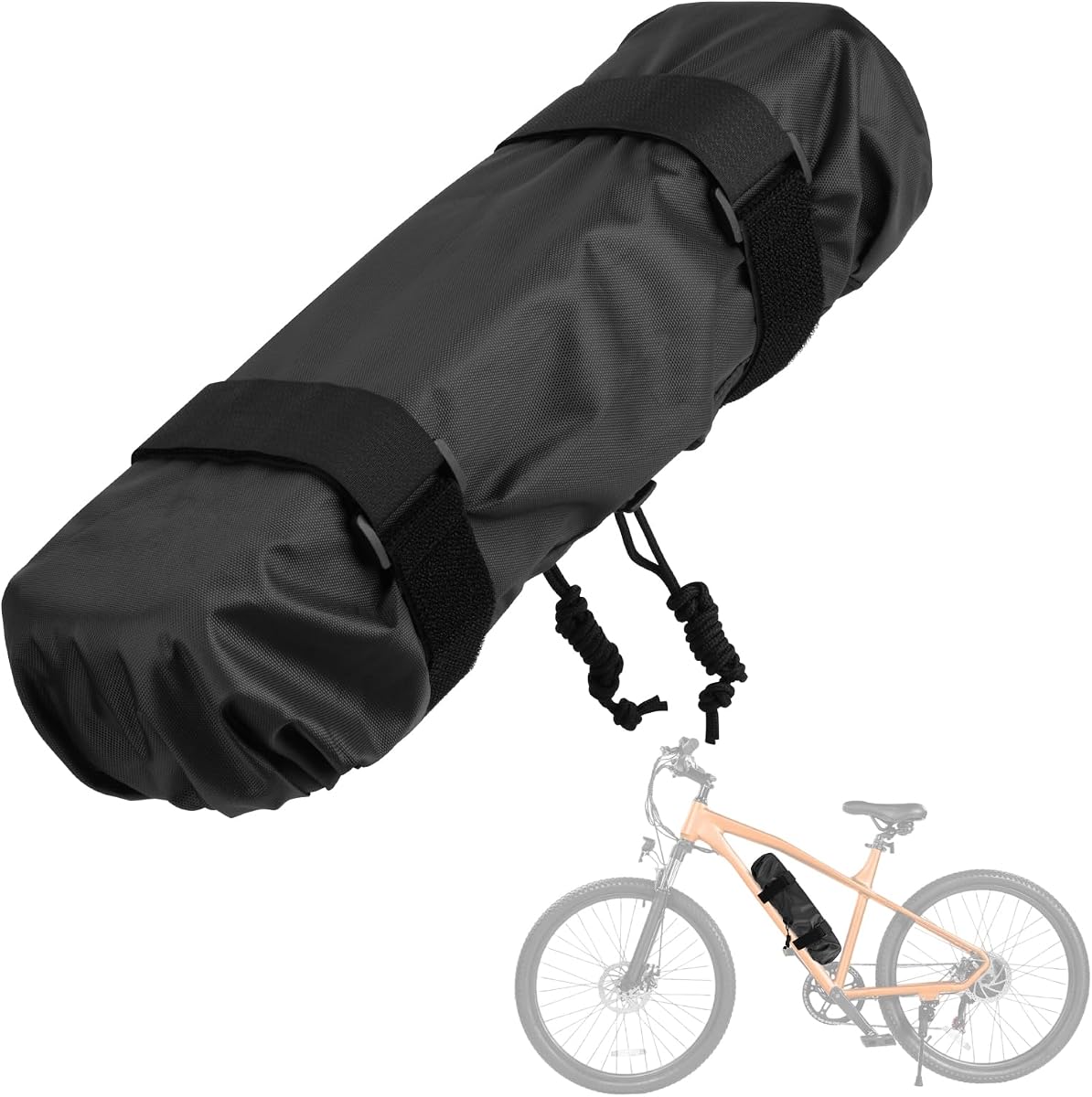
The Ebike Battery Protective Cover focuses on weather and dirt rather than fire containment. With a 4.4 rating, it offers a lightweight, flexible way to shield a battery mounted on a bicycle during rain, snow, mud, or dusty roads.
We may earn a commission when you buy through this link, at no additional cost to you.
Coated Oxford fabric is described as lightweight, durable, and wear-resistant. A stretch drawstring wraps closely around the battery, while a hook-and-loop fastening strap helps prevent the cover from falling away while riding. The listed size is 42 by 12 by 13 centimeters, intended to fit most e-bike batteries.
This product does not claim the same fire-resistant or explosion-resistant construction found in the dedicated charging bags. It also cannot compensate for a battery shape that falls substantially outside the stated dimensions. Riders with unusual battery designs should measure both the pack and its mounting area carefully.
It is best for riders whose battery normally remains on the bike and whose main concern is exposure to weather and scratches. The cover folds into a small size when removed, making it convenient to pack when the battery is taken indoors for charging.
The drawstring and hook-and-loop strap create a close fit without a complex installation process. Riders can install or remove the cover in seconds, which is useful when weather changes quickly.
Because the cover folds down, it takes up little room when a battery is carried separately. This makes it a practical companion to a more structured battery transport bag.
We may earn a commission when you buy through this link, at no additional cost to you.
The FLASLD Electric Scooter Battery Hanging Bag is a compact, bike-mounted option for riders who want both battery-risk reduction and small-item storage. Its 4.1 rating places it behind the larger dedicated cases, but its mounting versatility makes it relevant to different bikepacking styles.
We may earn a commission when you buy through this link, at no additional cost to you.
Loops around the bag's frame work with independent hook-and-loop straps, allowing installation under a seat or near a handlebar. The product information specifically notes that it can be positioned to avoid interfering with a water-bottle bracket. The triangular form is intended for phones, mini pumps, glasses, tools, masks, keys, and wallets.
Although the product uses the term fireproof in its marketing context, the supplied information explicitly says it is not completely resistant to flames from spontaneous battery combustion. It is best understood as a bag that can reduce risk and buy time rather than as guaranteed containment.
This option is useful for compact trips where every piece of luggage must earn its place. Riders who require a larger battery, extensive cargo capacity, or a strong charging-fire case should consider one of the dedicated protective bags instead.
Multiple loops and adjustable straps allow the bag to move between under-seat and handlebar positions. Riders can account for frame shape, water-bottle access, and handling preferences.
The compact triangular profile provides room for frequently used items while adding less visual and physical bulk than a full rear-rack organizer. It suits rides where quick access is more important than maximum capacity.
We may earn a commission when you buy through this link, at no additional cost to you.
The BiKase EBike Battery Bag is a refined solution for riders who want to carry an extra battery on a rear rack. It has a 4.5 rating and combines a waterproof, flame-resistant exterior with a flame-resistant liner and inner foam described as passing the FMVSS 302 Flame Test.
We may earn a commission when you buy through this link, at no additional cost to you.
Two separate sets of loop straps make mounting to a rear rack straightforward. The roll-top closure can be shortened or extended to suit the available space, helping the bag sit more neatly and remain secure. Its 245-cubic-inch volume can accommodate up to two small batteries or one larger battery, including larger 48- and 52-volt examples.
Because it is designed to mount behind the bike, frame clearance and rack strength deserve attention. A heavy battery can affect handling, and the bag should not obstruct the light, tire, or brake area. Proper closure is also essential for keeping the waterproof and flame-resistant layers doing their intended job.
This is the most refined choice for extended bikepacking routes where carrying spare power is central to the trip. Riders using a smaller frame without a suitable rack may need a compact case or frame-mounted alternative.
The capacity is tailored to the challenge of carrying one large pack or multiple smaller ones. That makes it more relevant than a general accessory bag for riders extending their range away from charging opportunities.
The roll-top closure changes length to suit the rack, while two strap sets stabilize the bag. Riders should confirm clearance and ensure the closure is fully secured before departure.
We may earn a commission when you buy through this link, at no additional cost to you.
The 40L Hard Shell Ebike Bag offers the largest conventional luggage system in the guide, with a 3.7 customer rating. Its selling point is comprehensive cargo organization: a dedicated battery compartment, removable dividers, expandable side panniers, and a rigid molded exterior.
We may earn a commission when you buy through this link, at no additional cost to you.
Waterproofing is addressed at three points in the design. Molded EVA side shells resist water, sealed zippers protect the openings, and a roll-top closure creates a further physical barrier. Five hook-and-loop straps secure the bag underneath and at the sides, while reflective strips and a taillight mounting position improve visibility.
The 3.7 rating is lower than those of the other products and should be considered carefully. No feedback-based analysis is provided here, so buyers should look for current customer comments about installation, zipper performance, and durability. The 40L volume may also be excessive for ultralight riders.
This bag is best for riders prioritizing weatherproof cargo space and a single organized rear-rack system. It can also be carried by the handle or shoulder strap for hiking, camping, or other activities, although that versatility does not change the size and weight of the full bag.
Combining sealed zippers, a roll-top closure, and molded waterproof shells creates several barriers against rain. This is a useful design for riders traveling through variable climates.
The 40L capacity can carry tools, pumps, clothing, locks, power banks, and other common bikepacking equipment. The detachable divider allows the battery area to remain distinct from general cargo.
We may earn a commission when you buy through this link, at no additional cost to you.
The BiKase E-Bike Battery Cover takes a minimalist approach with a fitted neoprene layer, earning a 4.5 rating. It is intended for riders who need basic protection from weather, dirt, and scratches while keeping the battery mounted or transporting it on a vehicle rack.
We may earn a commission when you buy through this link, at no additional cost to you.
Neoprene provides insulation that the description says can reduce power loss associated with cold conditions. The water-resistant material also helps keep the battery dry, while a close fit protects its exterior from marks and road grime. An added pocket provides space for a phone, keys, or wallet.
It does not offer the explicit fire-resistant construction found in several dedicated cases, nor does it provide the large organizational capacity of a hard-shell rear-rack bag. Riders with a substantial battery should also check whether the cover's fit allows the battery to remain fully seated on its mount.
The cover is a good companion for cold-weather commuting and general outdoor riding. It is especially attractive to riders who want a clean, unobtrusive solution that protects one battery without adding a large pannier or a conspicuous cargo system.
The neoprene layer is intended to help limit cold-related power loss. It does not create warmth, but it can provide a practical insulating layer between the battery and outdoor conditions.
A fitted cover keeps mud and scratches away from the battery's visible surfaces. The external pocket adds useful access without requiring a separate small bag.
We may earn a commission when you buy through this link, at no additional cost to you.
Choosing a battery pack solution for bikepacking means balancing battery fit, environmental protection, mounting method, and carrying capacity. Riders should also distinguish between a storage bag, weather cover, and charging enclosure because each addresses a different part of the journey.
Begin by measuring the battery's length, width, height, connector position, and mounting hardware. The listed products range from compact triangular bags to 40L rear-rack systems, so a case that seems generously sized on paper may still fail to match a narrow, curved, or unusually tall battery. Pay particular attention to the bag's stated internal dimensions and the orientation in which the battery must sit.
If the bag will be used during charging, in a vehicle, or inside a shared shelter, fire-resistant construction deserves high priority. Look for multiple layers, flame-retardant materials, secure closures, and clear manufacturer limitations. Extreme temperature claims should be treated as risk-reduction specifications rather than proof that a bag can withstand uncontrolled battery combustion under every condition.
Bikepacking routes can include rain, mud, snow, dust, and repeated spray from the tires. Water-resistant or waterproof materials help protect electrical contacts and the battery casing, while sealed zippers, roll-top closures, and fitted drawstrings offer varying degrees of protection. Riders should decide whether the battery stays mounted outdoors or is carried inside a pannier during the most exposed sections.
A battery bag must remain secure without interfering with the wheel, brakes, steering, lights, or water-bottle mounts. Strap-mounted rear-rack bags offer useful capacity but require a suitably rigid rack, while frame bags need compatible geometry. Check the fit list carefully and inspect all buckles, hook-and-loop closures, and roll-top seals before riding over rough terrain.
A 40L rear-rack organizer can carry tools, clothing, food, and electronics, but it is overkill for a rider traveling with minimal gear. Compact battery cases focus on one power pack and may weigh less. Because battery bags are mounted on the bicycle, their mass affects balance and handling differently from the same weight carried in a backpack.
Zippers provide convenient access but need careful alignment, while hook-and-loop closures are easy to adjust and can collect dirt. Roll-top closures shed water well but must be rolled and secured consistently. Hidden charging holes are helpful when a battery will be charged inside its bag, although they may be less suitable when a connector needs frequent attachment.
A battery charging bag is only one part of safe charging. It should be placed in an open area away from flammable materials, monitored with an appropriate charger, and used with a healthy battery and undamaged wiring. A ventilation-conscious rider should also check local rules and the battery maker's instructions before charging indoors or inside a tent.
Reflective details help with low-light visibility, particularly when a bag hangs behind the bicycle or is removed at camp. Separate pockets and dividers can also keep a phone, wallet, pump, or tools from pressing against the battery. These secondary benefits matter when the product serves as a general bikepacking organizer rather than a single-purpose battery sleeve.
Before the first ride, compare the battery with the bag's internal dimensions and confirm that the mounting hardware, cable route, and closure do not interfere with one another. Install a frame or rack bag while the bicycle is upright, tighten every strap evenly, and make several short adjustments. Check the bag again after the first few kilometers because luggage and suspension can shift.
Inspect the battery and bag before and after every ride. Look for torn fabric, damaged zippers, loose Velcro, pinched charging leads, corrosion, dents, swelling, unusual heat, or moisture inside the enclosure. Let a damp bag dry fully before closing it, and clean the exterior with mild soap and water where appropriate. Avoid machine washing, high heat, harsh solvents, and charging a wet battery.
For charging, use a compatible charger on a stable, nonflammable surface and follow the battery manufacturer's instructions. A fire-resistant bag can help slow the spread of heat or flames, but it does not eliminate risk. Keep the enclosure in an open area away from fuel, tent fabric, paper, and other combustible material, never leave charging unattended, and remove the battery for service if it shows signs of damage.
No. The listed products are bags, covers, and storage solutions for e-bike batteries rather than battery packs or chargers themselves. They are included because bikepacking riders need to protect, carry, organize, and transport the batteries they already own.
No. A fire-resistant bag is an added layer of containment intended to reduce the chance that heat or flames spread. Riders should still use a compatible charger, inspect the battery, charge in an open area away from flammable materials, and never leave the process unattended.
Measure the battery's longest side, width, and height, then compare those numbers with the product's stated dimensions. Also check the battery's shape, mounting rails, connector location, and the amount of clearance available on your rack or frame.
It depends on the exposure. A fitted waterproof cover may be adequate for a mounted battery in ordinary rain, while a sealed hard-shell rear-rack bag offers more protection for a trip in sustained bad weather. Riders should keep vulnerable connections protected and move the battery into a dry bag when practical.
It can be useful on routes with long gaps between charging opportunities, provided the rack is strong enough and the battery is secured properly. A rack-mounted battery affects balance, so riders should test handling with the full load and avoid loose bags or straps that could contact the wheel.
Some products are described as suitable for various lithium battery formats, but fit and safety requirements vary. Riders should follow the manufacturer's size guidance and use only with batteries and chargers that are approved for the intended application.
A compact protective cover or dedicated fire-resistant pouch is usually more appropriate than a 40L rear-rack bag. It adds less bulk and may serve as a temporary location for a phone, keys, or a small repair item while keeping the battery separated.
Let the bag dry before closing it, remove loose dirt with a soft brush, and wipe the exterior with a damp cloth. Use mild soap where the material permits it, but avoid soaking zippers, closures, and any fire-resistant lining unless the manufacturer specifically allows it.
The FLASLD Fireproof E-Bike Safe Bag stands out for its strong customer rating and balanced combination of fire, explosion, and water resistance. The Fireproof E-Bike Battery Bag Case offers a more elaborate six-layer design with charging-oriented closures, while the BiKase EBike Battery Bag is the most polished choice for securely carrying a spare battery on a rear rack.
For riders who need a full bikepacking luggage system rather than a single battery enclosure, the KEMIMOTO and 40L hard-shell bags provide much more organization, dedicated battery compartments, weather features, and reflective details. Minimalists should consider a fitted cover or compact case, while electric dirt bike riders can evaluate the model-specific frame bag.
Before buying, verify the battery dimensions, rack or frame compatibility, closure system, and current customer feedback. Prices and product availability can change, so checking the live listing can help confirm the correct size and the most current product information before ordering.