
Ahopegarden 10 Pods
4.5Editor score
Ten hydroponic planting stations
Two full-spectrum light modes
Visible reservoir water level
An indoor hydroponics growing system makes it possible to cultivate herbs, leafy greens, vegetables, and compact fruit crops without outdoor soil. A worthwhile model combines adequate grow lighting, dependable water circulation, simple controls, enough plant capacity, and a design that fits your available counter or floor space.
We compared all ten systems by examining pod capacity, reservoir size, lighting controls, circulation methods, app functions, adjustability, maintenance requirements, and suitability for beginners or experienced growers. The guide covers countertop gardens, vertical towers, multi-tier systems, and larger cabinet-style indoor farms.
Each review identifies the strongest reason to consider a particular model and any meaningful limitations. The top selections represent different priorities: straightforward value, connected automation, and premium capacity. Product configurations and prices can change, so confirm the current listing and included accessories before purchasing.
4.5Editor score

4.4Editor score

4.1Editor score
As an Amazon Associate we earn from qualifying purchases.
The comparison below highlights major differences in capacity, lighting, automation, and physical design, helping you identify the indoor hydroponics system that best matches your space and growing goals.




The Ahopegarden 10 Pods combines a water reservoir, overhead full-spectrum LED light, and circulation system in a compact countertop format. Its 4.5 rating reflects a strong balance of straightforward operation and useful growing features, making it a practical starting point for people who want indoor hydroponics without navigating a complicated control system.
We may earn a commission when you buy through this link, at no additional cost to you.
Ten growing stations provide enough room for a varied collection of herbs and leafy vegetables. The lighting post adjusts to 14.5 inches, allowing plants to move closer to the lamp as they grow, while a 16-hours-on, 8-hours-off timer provides consistency. Separate vegetable and flower-and-fruit modes help tailor the light to different stages and crop types.
The transparent water-level window is one of the most useful practical details. Users can check the reservoir without opening the unit, and the internal circulation system is designed to keep the water moving. The trade-off is limited automation: unlike connected competitors, this model offers physical controls rather than remote scheduling, notifications, or growth tracking.
This is our best overall pick for value-conscious beginners and households seeking a manageable first indoor garden. It supports a useful number of plants, occupies relatively little counter space, and avoids the learning curve associated with smartphone-based systems. It is less suitable for growers who want remote monitoring or the flexibility of a substantially taller light post.
The straightforward controls make this system approachable for first-time growers. Add seeds, water, and nutrients to the reservoir, select the appropriate light mode, and let the timer manage the basic daily cycle.
Ten stations support herbs, greens, and compact crops, while the external water window reduces guesswork when checking reservoir levels. The adjustable post also helps prevent tall seedlings from reaching the light prematurely.
We may earn a commission when you buy through this link, at no additional cost to you.
The LetPot 12 Pods stands out as the most connected model in this guide, with app and Wi-Fi control, lighting customization, watering reminders, and growth-day tracking. Its 4.4 rating reflects a capable and flexible package for growers who want more control than a basic timer provides.
We may earn a commission when you buy through this link, at no additional cost to you.
The 24-watt full-spectrum light can run on a user-defined schedule from zero to 24 hours. Vegetable and flower-or-fruit modes are available, allowing users to adjust the balance of blue and red light according to crop requirements. The app can also record growing days, while reminders help prevent the kind of forgotten watering routine that can undermine an indoor garden.
The included 12-cup package contains sponges, baskets, covers, and A&B nutrients, so it offers a more complete starting setup than many competitors. A 5.5-liter tank is claimed to support up to three weeks of growth without watering, although actual intervals depend on plant maturity, temperature, and environmental conditions. The lighting rod adjusts to 30 inches, giving tall plants considerably more clearance.
This is the right choice for someone who values automation and remote information. The app dependency may be unnecessary for a hands-off basic garden, and the plant count is modest for ambitious growers. Even so, the combination of precise controls, reminders, a long adjustable post, and a reasonably generous reservoir makes it a particularly balanced connected system.
Customizable lighting schedules, watering reminders, and growth tracking reduce the need to monitor the system manually. These functions are especially useful when the garden is away from a frequently visited kitchen counter.
The 30-inch adjustable rod separates the canopy from the LED as plants mature. Combined with dedicated crop modes, it provides more flexibility than shorter countertop systems with fixed-height lighting.
We may earn a commission when you buy through this link, at no additional cost to you.
The Ahopegarden 12 Pods offers a polished 17-inch vertical design with an integrated LCD touchscreen. Its 4.5 rating and easy-to-read control panel make it attractive for users who want modern conveniences without setting up a separate smartphone application.
We may earn a commission when you buy through this link, at no additional cost to you.
Twelve stations can hold herbs, leafy greens, and suitable compact plants, while dual light modes support different varieties. The system offers a 22-hour mode intended for heavier flowering and fruit development, along with a quieter 16-hour setting. Its adjustable height helps accommodate taller stems and reduce the chance of light burn.
Water management centers on a 5-liter reservoir and an ultra-quiet pump operating on a 30-minute cycle. That regular circulation is designed to keep water fresh and support root oxygenation. The practical trade-off is that this is a self-contained local system without remote notifications, water-level alerts, or the deeper scheduling features found in the LetPot models.
This system is well suited to apartments, offices, and kitchens where appearance and convenient touch controls matter. It is a strong alternative for people who dislike app setup but want more operating options than a simple mechanical timer. Its 12 stations and vertical footprint make it especially useful for herbs and greens rather than a very broad mixed crop garden.
The LCD panel provides direct access to lighting and circulation settings. This keeps daily operation understandable while avoiding the need to unlock a phone or depend on wireless connectivity.
Its narrow 17-inch profile uses vertical space efficiently, while the 16- and 22-hour options let growers select a standard light cycle or a longer flowering-oriented schedule.
We may earn a commission when you buy through this link, at no additional cost to you.
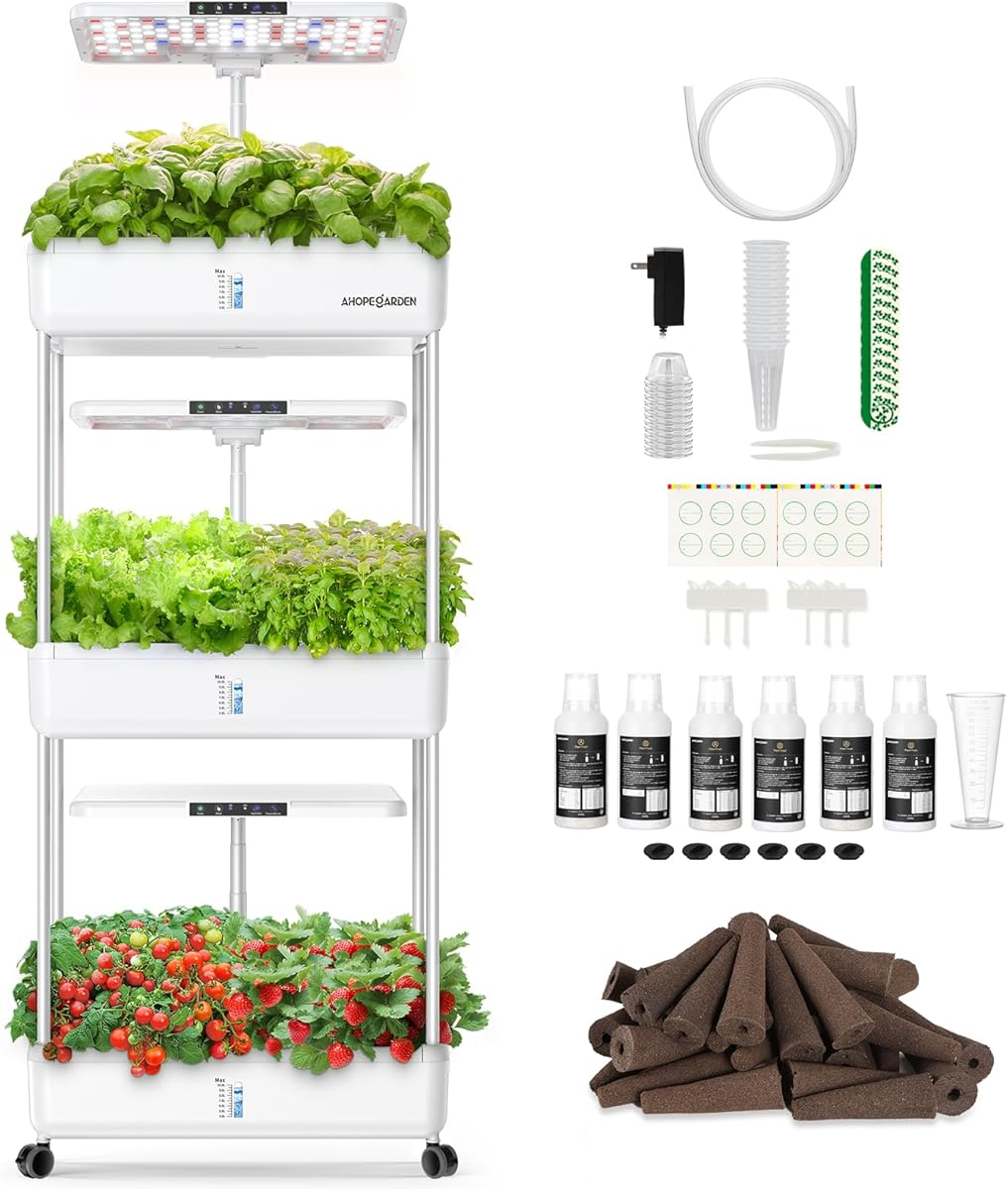
The Ahopegarden 66 Pods is built for serious indoor production, combining a 66-position growing area with three tanks, independent pumps, and a high-output 53-watt grow light. Its 4.5 rating makes it one of the strongest options for families or dedicated growers who want substantial capacity.
We may earn a commission when you buy through this link, at no additional cost to you.
The three 10-liter reservoirs divide the system into independent planting zones. That arrangement can reduce cross-interference between crops and permits more tailored management than one shared reservoir. Independent pumps circulate water within each zone, supporting oxygen delivery and consistent nutrient movement across the large garden.
The light offers 16- and 22-hour modes, with the longer setting intended to support flowering crops and improve sugar development in vegetables such as tomatoes. An adjustable lighting post, collapsible frame, and 360-degree mobility make the unit adaptable, although the assembled structure is considerably larger and more involved than a basic countertop kit.
This model suits users with sufficient floor space who want to grow herbs, greens, strawberries, and fruiting crops in greater volume. The size and multiple tanks increase maintenance demands, and a household wanting only a few culinary herbs may find it excessive. For high-output indoor gardening, however, the capacity and zoned circulation are compelling advantages.
Separate tanks and pumps reduce interaction between growing areas. This is useful when different plants have varied nutrient, water, or lighting needs and when you want more control over each section.
Sixty-six positions support a large collection of plants, while the wheeled frame helps reposition the unit. Adjustable lighting and collapsible construction assist with setup and maintenance, although more parts require careful assembly.
We may earn a commission when you buy through this link, at no additional cost to you.
The Growell 81 Pods is the highest-capacity product in this comparison, with 81 planting positions distributed across four independently managed tiers. Its 4.0 rating reflects a substantial and versatile design, though it is more involved than a standard countertop garden.
We may earn a commission when you buy through this link, at no additional cost to you.
Each tier has a dedicated 14-liter tank and independent water pump, creating a self-contained water cycle every 30 minutes. The isolated arrangement can prevent cross-tier interference and offers a more targeted approach to moisture and nutrient management. A clear water-level indicator makes reservoir checks easier despite the system's size.
Each tier receives a 26-watt full-spectrum grow light with dedicated vegetable and flower-and-fruit modes. The panels adjust as plants change height, and the complete unit rests on lockable wheels for movement and stability. At under 20 decibels, the pumps are designed for quiet operation, although the full-sized structure may still dominate a room.
This system is best for a dedicated indoor growing area and users aiming for continuous harvests of lettuce, basil, tomatoes, microgreens, and herbs. It is less appropriate for small kitchens because of its size, and its 4.0 rating makes it less compelling than several similarly capable alternatives. Its defining advantage remains the impressive 81-position layout and isolated tier management.
A separate tank and pump for each level creates four distinct growing environments. This isolation is useful for mixed crops and simplifies the idea of managing one large shared reservoir.
The 81-position layout supports extensive indoor harvests, and lockable casters let users move the garden when necessary. Adjustable lighting panels accommodate changing canopy heights as different crops mature.
We may earn a commission when you buy through this link, at no additional cost to you.
The LetPot 10 Pods delivers connected hydroponic gardening in a relatively compact format. Its 4.5 rating reflects a strong feature set for users who want app-based lighting control, water alerts, and customization without moving to a large multi-tier installation.
We may earn a commission when you buy through this link, at no additional cost to you.
The 24-watt full-spectrum light supports adjustable brightness, customizable light modes, and scheduling across a 24-hour range. The app also provides water-level alerts and a silent mode, helping users keep the system running with less attention. It can track useful conditions remotely, making it convenient for gardens located outside the main kitchen work area.
The 4-liter tank is claimed to sustain growth for 14 to 21 days between water additions, though actual timing changes with plant maturity and room conditions. The lighting rod extends to 14 inches, giving less clearance than the larger LetPot LPH-SE. Seeds are not included, so buyers must select suitable seeds separately and account for that in the initial setup.
This is a particularly good fit for busy households, families, and beginners who appreciate guided controls. The app adds convenience but also introduces connectivity and setup considerations. It is best for compact spaces and shorter crops such as herbs, lettuce, and other leafy greens rather than a large collection of tall plants.
App scheduling, water alerts, and dimming options bring useful automation to a ten-pod format. The system can be managed from different rooms, although reliable Wi-Fi and initial app configuration are important.
The reservoir is intended to support extended periods without manual watering. A water-level alert can notify users before problems develop, though users should still inspect the garden and confirm local water conditions regularly.
We may earn a commission when you buy through this link, at no additional cost to you.
The Gardyn Home 4 is a premium vertical indoor farm designed to cultivate 30 large plants in approximately two square feet. Its 4.1 rating is slightly below the leaders, but the system's compact footprint, included starter plants, and advanced monitoring distinguish it from conventional pod gardens.
We may earn a commission when you buy through this link, at no additional cost to you.
The system uses redesigned columns intended to simplify cleaning, energy-efficient LED lighting, and real-time water measurement. Sunrise and sunset modes create gradual lighting transitions rather than relying only on abrupt on-and-off cycles. Kelby, the included AI plant coach, uses system sensors to provide personalized care tips, while a 30-day trial and ten bonus yCubes are included.
Thirty yCubes arrive with a mix of vegetable, herb, and leafy-green seeds planted in rockwool, giving users an immediate start without soil. The vertical format maximizes output without requiring a broad countertop, making it interesting for apartments and modern kitchens. The trade-off is the significant investment and reliance on connected technology, which may be excessive for occasional growers.
This model is ideal for users who want a polished, integrated indoor food garden and enough capacity for a substantial household harvest. It is less suitable for someone seeking a simple manual system or a very small herb collection. Even so, the included plants, vertical efficiency, and sensor-assisted guidance make it a credible premium alternative.
The Home 4 concentrates 30 large growing positions into roughly two square feet. That makes it practical for apartments and kitchens where a traditional horizontal garden would consume too much surface area.
Real-time water measurement and Kelby's sensor-based guidance help users make informed adjustments. The technology is most useful for dedicated growers willing to engage with the app and follow the system's recommended care process.
We may earn a commission when you buy through this link, at no additional cost to you.
The owltron 15 Pods combines a comparatively large plant count with a powerful 36-watt light and a 30-inch extendable pole. Its 4.5 rating makes it one of the strongest systems for mixed indoor crops, particularly when vertical plant clearance matters.
We may earn a commission when you buy through this link, at no additional cost to you.
The Smart Life app gives control over a 0-to-24-hour light cycle, vegetable and flower-or-fruit modes, and ten dimming levels. The default schedule is 16 hours on and eight hours off, but users can alter timing for different requirements. The quiet pump circulates water every 30 minutes to oxygenate roots and distribute nutrients.
A 5.5-liter tank and external low-water indicator simplify reservoir care, while a removable LED pole helps with cleaning. Stainless-steel construction and the detachable light assembly support routine maintenance. The principal limitation is the reliance on app-based controls for its more advanced settings, which may be less convenient for users who prefer physical controls.
This is an excellent match for families and indoor growers who want a meaningful number of planting positions without moving to a floor-standing tower. The 15 sites, 36-watt lamp, and tall adjustable pole create room for herbs, lettuce, peppers, and strawberries. It is especially suitable for people comfortable using a general smart-home application.
The 36-watt lamp provides a higher output than many compact kits, while the 30-inch pole allows mature plants to remain properly spaced. This combination is beneficial for mixed gardens that include both leafy crops and taller plants.
Ten brightness levels, crop-specific modes, and adjustable timing give users considerable control. The app also tracks growing days, and the low-water indicator adds a useful physical cue for reservoir maintenance.
We may earn a commission when you buy through this link, at no additional cost to you.
The JESLED 6 Tiers uses a narrow vertical structure to bring indoor food growing into spaces with limited counter or floor area. Its 4.5 rating reflects an efficient design, flexible timers, and supplemental lighting, although its spiral planting approach differs from standard pod gardens.
We may earn a commission when you buy through this link, at no additional cost to you.
Four LED grow lights provide 5000K full-spectrum illumination with four-sided supplemental coverage. The dual-timer setup can circulate water every 15 minutes and operate the lights for 8 to 16 hours. These controls reduce manual scheduling, while the system's claimed water reduction makes it attractive for users focused on efficient indoor production.
The BPA-free reservoir has an external water-level indicator and enough stated capacity for two to three weeks under a full load. Its circulation pump operates below 30 decibels. The opaque tank limits light penetration, and leak-proof connections are used at key points, but the installation instructions remain important because the tower uses a one-step spiral planting method.
This tower is best for beginners, classrooms, and small homes that need many growing levels in a narrow footprint. It is less suitable for users who want flexible pod placement or remote app monitoring. The design rewards a structured approach: plants are trained through the tower, supplemental lighting reaches multiple sides, and the timers automate the daily routine.
The six-tier arrangement concentrates plants vertically, while four-sided lighting supports plants at different levels. This configuration can deliver meaningful output without requiring a wide growing table.
Independent timing for the pump and lights makes daily care more consistent. The external gauge and long reservoir interval further reduce maintenance, although seedlings still need close observation during establishment.
We may earn a commission when you buy through this link, at no additional cost to you.
The Gardyn Studio 2 is a sleek smart tower for growing up to 16 non-GMO plants within a relatively compact footprint. Its 4.3 rating reflects a refined design and capable monitoring tools, though it occupies the premium end of the market.
We may earn a commission when you buy through this link, at no additional cost to you.
The wide high-resolution camera captures the vertical garden for remote viewing, while Kelby, Gardyn's AI assistant, provides plant-health monitoring and personalized care tips. Sunrise and sunset modes create more gradual changes in illumination than a basic timer, supporting a natural daily rhythm and adding visual appeal to the surrounding room.
Waterproof silicone seals and no-cleaning columns are intended to reduce buildup and crystallization, which are recurring maintenance issues in some hydroponic systems. The package includes the tower, advanced LEDs, a starter seed kit, sensors, and a camera, along with step-by-step instructions and app integration. The trade-off is the high investment and the learning curve associated with a sensor-rich platform.
This system fits users who want a modern vertical garden and are comfortable with app-based monitoring. It is less compelling for a casual grower who only needs a few herbs, and more expensive large-capacity systems offer many more planting positions. Its strongest appeal lies in combining a discreet footprint, enclosed columns, camera visibility, and automated guidance in one polished design.
The integrated camera provides a broad view of the tower, making it easier to observe growth and spot changes without walking to the garden. This visibility adds convenience and educational value.
Sealed columns are designed to limit residue and crystallization, reducing the cleanup associated with exposed hydroponic channels. Easy-access construction and a vertical format keep routine care organized.
We may earn a commission when you buy through this link, at no additional cost to you.
The right indoor hydroponics system depends on your space, crop mix, and preferred level of automation. Evaluate capacity, lighting, water management, maintenance, and included accessories before comparing models.
Start by estimating how many plants you realistically want to grow and which crops you expect to harvest. Ten- to 15-pod systems suit culinary herbs, lettuce, and compact vegetables, while 66- and 81-position installations are intended for high-volume production. Vertical towers can provide multiple levels in a narrow area, but their fixed planting arrangement may offer less flexibility than individual horizontal pods.
Larger is not automatically better. A full-capacity system requires more lighting, water, nutrients, cleaning, and attention. Match the system to your actual use rather than the maximum number it can hold.
Hydroponic plants depend on consistent artificial light, so look for a full-spectrum lamp, dedicated crop modes, and a timer that matches plant requirements. Adjustable lighting is important because seedlings need more intensity than mature leaves while tall plants need the fixture raised to avoid heat or light damage. App dimming and custom cycles can add convenience.
Choose a light that reaches the full height of your intended crops. A high-wattage fixture is not automatically superior if its panel cannot be positioned effectively, but higher output can be helpful for dense or mature plantings.
The reservoir should supply enough water for the root zone while remaining manageable to fill, clean, and monitor. Look for a visible water-level window or external indicator, a pump that circulates regularly, and a tank size proportionate to the number of plants. Larger systems need more attention to leaks, sanitation, and stable nutrient levels.
Advertised watering intervals are best treated as estimates. Temperature, plant size, humidity, and light exposure can change how quickly a reservoir is depleted, so inspect it often even when the manufacturer suggests a multiweek interval.
App control can provide remote schedules, water reminders, growth tracking, and light-mode adjustments. These functions are valuable when the garden is not in a primary workspace or when you want a consistent routine. Physical controls remain useful as a backup, and some users may prefer a system that works entirely without a phone.
Consider notification quality, scheduling flexibility, and whether the app adds genuinely useful information. Connected features are not essential for every crop, but they can reduce missed watering and inconsistent lighting.
Measure the final setup rather than relying only on the product's capacity. Countertop models need vertical clearance for the light, while large towers require adequate floor space and room to reach every level. Adjustable posts and lighting panels help accommodate growth, but the maximum height should match the mature plants you plan to grow.
For tall herbs, peppers, and strawberries, prioritize vertical adjustment. For compact greens, a shorter unit may be sufficient and easier to maintain. Also consider how the system looks in the room, since many indoor gardens remain on display.
Hydroponic systems require reservoir cleaning, root-zone checks, and periodic attention to the pump and connections. Removable tanks, detachable lighting poles, open reservoirs, sealed columns, and cleaning conduits make upkeep easier. The design should also allow you to reach every planting position without dismantling the entire frame.
Choose the level of automation that matches your commitment. A garden with reminders and easy-clean components is more approachable for beginners, while elaborate systems may need regular attention to preserve performance.
Some kits include planting cups, baskets, sponges, covers, nutrients, or starter seed packs, while others require separate supplies. Check the contents before buying so you can prepare the complete growing setup at once. A reservoir alone is not a complete system, and missing seed pods or nutrients can delay the first planting.
Avoid assuming that every attractive crop is suitable for indoor hydroponics. Select compatible seeds and begin with crops known to work well in the system's space and light. Add accessories only after the core unit is installed and operating correctly.
Pump noise matters in kitchens, bedrooms, offices, and shared living spaces. Specifications such as under 20 decibels or below 30 decibels indicate an effort to operate quietly, though perceived sound also depends on the surface and room. Design should match your space: compact units suit counters, towers fit narrow zones, and large multi-tier gardens need a dedicated footprint.
Also consider cleaning access and whether household members will move the unit. Lockable wheels, adjustable panels, and detachable components can make a large system more practical over time.
Begin by assembling the system in a clean, level location with access to power and water. Check all tubing, pump connections, and reservoir seals before adding liquid. Install the appropriate growing medium and seeds in each basket or cup, then position the grow light at the recommended distance from the seedlings.
Fill the reservoir with the required water and nutrients, following the manufacturer's directions carefully. Activate the circulation pump and confirm that water reaches the root zone without flooding the lighting or electronics. Set the appropriate plant mode and lighting schedule, using the shorter daily cycle initially if the product offers multiple durations.
Inspect the system daily during the first weeks. Check root color, plant stability, water level, pump operation, and signs of heat stress. Top up the reservoir as needed, clean the reservoir on the recommended schedule, and adjust the light height as plants grow. Continue to monitor app alerts, but do not treat them as a substitute for physical inspection.
A system with 10 to 15 growing positions is generally the easiest starting point for a beginner. It can produce a useful mix of herbs and leafy greens without requiring the large reservoir, frame, or maintenance associated with a high-capacity installation. Choose a model with clear water-level indicators and simple or app-assisted controls.
No. These systems deliver water and dissolved nutrients directly to the root zone. Most pod-based models use foam or sponge-style growing media to support seeds and roots, while other vertical systems use rockwool or another included medium. The growing medium is primarily structural rather than a source of nutrition.
The ideal interval depends on the plant count, reservoir size, crop maturity, and ambient temperature. Use the manufacturer's guidance as a starting point, but also monitor the water level and appearance. Small gardens may need more frequent attention, while larger systems can go longer between changes under stable conditions.
Some systems are tall and powerful enough for compact tomato cultivars and other fruiting plants. Look for a 22-hour flowering mode, a high-output full-spectrum light, and an adjustable lamp with enough clearance. Even then, fruiting crops require more light, nutrients, pruning, and attention than leafy greens or herbs.
App control is convenient for precise schedules, remote notifications, and water-level warnings, but it is not automatically better for every user. Manual systems are simpler, usually involve fewer setup steps, and remain useful without a wireless connection. Choose based on how much automation will genuinely improve your routine.
A tower arranges plants vertically in a narrow footprint and commonly uses a spiral planting method with side or supplemental lighting. A pod garden provides separate horizontal planting cups, usually under one overhead lamp. Pod systems generally offer more flexible crop placement, while towers can provide more levels in less floor space.
Slow growth can result from inadequate light, an unsuitable light schedule, low water temperature, nutrient imbalance, or root problems. Check that the pump is circulating water, confirm the roots remain in the reservoir, and inspect the lamp position and operating mode. Seedlings also require an appropriate establishment period before vigorous growth becomes visible.
Use an opaque or covered reservoir, keep the light fixture from shining directly into the water, and avoid leaving the reservoir open to unnecessary light. Clean the system on the recommended schedule and remove fallen plant material promptly. Consistent circulation and proper lighting schedules also help maintain a cleaner growing environment.
The Ahopegarden 10 Pods is the most approachable overall choice for beginners and value-conscious households, while the LetPot 12 Pods offers the strongest combination of app scheduling, reminders, and adjustable lighting. For users seeking a premium, space-efficient indoor farm, the Gardyn Home 4 provides vertical capacity, starter plants, and intelligent monitoring.
Prioritize the features that match your actual routine: adequate plant capacity, sufficient light, a manageable reservoir, clean access, and controls you will genuinely use. Large systems can produce more, but they also require more time and space, while connected models are most helpful when remote scheduling and alerts solve a genuine problem.
Before purchasing, confirm the current product configuration, included accessories, dimensions, and warranty details. Features and pricing can change over time, and a listing may be updated during the year. Checking those details ensures that the chosen indoor hydroponics growing system remains a practical match for your home.